
Edith of Wessex had spent her entire life preparing for power. Educated at one of England’s finest abbeys, fluent in five languages, married to a king at twenty, she’d worked for two decades building her family into the most powerful dynasty in England. Her brothers controlled the north and south. Her husband sat on the throne. She was the fourth-wealthiest person in the kingdom.
Then 1066 happened.
Table of Contents
Three weeks in autumn changed everything. When the dust settled and the bodies were counted, Edith faced a choice that would define the rest of her life. What she decided next determined whether she’d die stripped of everything she’d built, or whether she’d find a way to survive the impossible.

The Godwin Family Power Play
Edith was born around 1025 into a family that specialized in accumulating power. Her father, Godwin, started as a minor Saxon noble and worked his way up by being useful to whoever held the throne. He’d been a warrior under King Cnut, helped suppress a rebellion in Denmark, and married Gytha, Cnut’s sister-in-law. By the time Edith was old enough to understand politics, her father controlled Wessex and had enough influence to make or break kings.
Godwin had a plan. He sent Edith to Wilton Abbey near Salisbury, where the daughters of powerful families learned to be useful. Edith studied Latin, French, Danish, and Irish. She learned arithmetic, astronomy, grammar, and rhetoric. She mastered embroidery and weaving. Wilton Abbey had a reputation for producing cultured, educated women, and Edith absorbed everything they taught her.
In 1042, Edward returned from exile in Normandy to claim the English throne after years of Danish rule. Edward owed Godwin for supporting his claim, but the relationship was poisoned from the start. Edward blamed Godwin for the murder of his brother Alfred years earlier. They spoke different languages. Edward preferred his Norman friends. And Godwin was always more powerful than the king he’d helped create.
So Godwin demanded Edward marry his daughter. Edward agreed because he needed Godwin’s military support and couldn’t afford to refuse.
A Marriage Without Heirs
Edith married Edward on January 23, 1045. She was about twenty, and he was forty. Unlike most Saxon queens, Edith was actually crowned, which gave her an unusual status and authority. She took on the responsibility of managing Edward’s royal image, dressing him in expensive clothes and jewels, commissioning a gold and gem-encrusted staff for him to carry, and decorating their apartments with Spanish carpets. She made him look like a king.
The marriage produced no children. This became the central tragedy of Edith’s life and the succession crisis that would tear England apart.
Later, religious writers invented stories about why. Edward took a vow of celibacy. The marriage was spiritual, not physical. Edward refused to consummate it because he hated the Godwins. Modern historians dismiss most of this as propaganda.
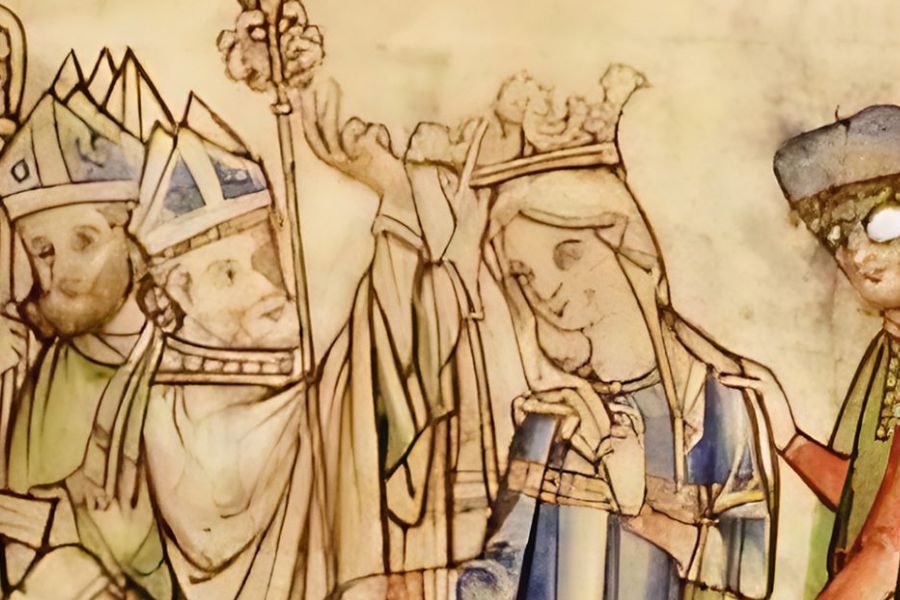
Edward’s biographer, Frank Barlow, stated bluntly that theories of deliberate abstention lack authority, plausibility, and diagnostic value. The most likely explanation is simple infertility. Edward never fathered illegitimate children either, which was unusual for medieval kings.
But the lack of an heir left Edward’s succession dangerously unclear and gave Edith’s family even more power. If there was no direct heir, whoever controlled England when Edward died would decide what came next.
Hooked on the Middle Ages? Get more stories like this one in your inbox.
Exile and Return
In 1051, everything fell apart. A riot in Dover left several Normans dead, so Edward ordered Godwin to punish the town. Godwin refused, and both men raised armies. Neither wanted civil war, so they took the dispute to the Witan, the council of nobles. The Witan sided with Edward. Godwin and most of his sons fled to Flanders. Harold and his brother Leofwine went to Ireland.
Edith was sent to a nunnery, and Edward confiscated her lands. The childless marriage was probably headed for divorce.
But Godwin wasn’t finished. In 1052, he returned with an army. Edward prepared to fight but couldn’t gather enough support. The Godwin family was too popular, too powerful, too essential, and Edward backed down. Godwin then begged forgiveness, and Edward restored the family’s lands and titles, and Edith returned to court as queen.
After 1053, when Godwin died, and Harold became Earl of Wessex, Edith’s brothers effectively controlled England. Edward spent his time hunting and working on his great project, the rebuilding of Westminster Abbey. Edith became one of his inner circle of advisers. Contemporary sources describe her as determined, interfering, hard, and probably bad-tempered. She witnessed charters, accumulated relics from other abbeys for her beloved Wilton, and she secured her brother Tostig’s appointment as Earl of Northumbria in 1055.
By the time Edward died in January 1066, Edith was the fourth-wealthiest person in England after the king, the Archbishop of Canterbury, and her brother Harold.

The Year Everything Ended
Edward the Confessor died on January 5, 1066. According to the Vita Edwardi Regis, the biography Edith later commissioned, Edward named her brother Harold as his heir on his deathbed. The Witan elected Harold king the next day.
But William of Normandy, Edward’s cousin, claimed Edward had promised him the throne years earlier. Harold had supposedly sworn an oath to support William’s claim. Now, Harold had broken that oath and stolen the crown.
William began preparing for an invasion.
Edith’s brother Tostig, angry after being forced into exile the previous year over his brutal rule in Northumbria, allied with Harald Hardrada of Norway and invaded northern England in September. Harold marched north and defeated them at Stamford Bridge on September 25. Tostig died in the battle.
Three days later, William landed on the English coast.
Harold immediately marched south, exhausted from the northern campaign. The armies met at Hastings on October 14, and as we all know, Harold died. So did Edith’s brothers Gyrth and Leofwine. Another brother, Wulfnoth, was already imprisoned in Normandy as a hostage. Harold’s sons fled to Ireland.
In three weeks, the Godwin family went from ruling England to near extinction. Edith was the only senior member left on English soil.
Survival Through Submission
William’s men came to Winchester, where Edith was staying, demanding tribute. She did the only thing she could do: she paid and submitted, allying herself with William.
William, recognizing the value of cooperation from the old regime, allowed Edith to keep most of her estates and income. While other Anglo-Saxon nobles lost everything, Edith remained one of the wealthiest women in England.
Edith spent her remaining years quietly. She commissioned the Vita Edwardi Regis, the Life of King Edward Who Rests at Westminster, written by an unknown Flemish monk. The work is remarkable for what it reveals about Edith’s priorities. She’s the hero of the story; her father and brothers are portrayed sympathetically, and their failures are blamed on others. The book presents Edward as a saint and Edith as virtuous, noble, and pious.
It’s propaganda, but it’s effective propaganda. The Vita became one of the most important primary sources for the period and shaped how later generations understood the events of 1066.
The Legacy She Chose
Edith of Wessex died at Winchester on December 18, 1075. She was around fifty years old and had been suffering from an illness for some time. William the Conqueror arranged her funeral. She was buried beside Edward in Westminster Abbey, the church Edward had spent years rebuilding and never lived to see completed.
Edith understood power better than most people who lived through 1066. She knew when to fight and when to submit. She knew how to negotiate from a position of weakness and understood that survival sometimes requires making deals with people you’d rather see dead. And she knew that controlling the narrative about what happened matters almost as much as what actually happened.
She was England’s last Anglo-Saxon queen. She watched her family’s dynasty end in blood at Hastings, and survived by being smarter, more pragmatic, and more ruthless than the men who thought they were using her.
Love a good medieval story?
Join our readers and get tales of kings, queens, castles and ordinary medieval lives straight to your inbox.
Kylie Lang is a nationally syndicated travel journalist with bylines on the Associated Press Wire & more, a medieval history writer, and the founder and lead author of Tales of the Middle Ages (talesofthemiddleages.com). She holds a BA (Honours) in History from the University of Kent and is a member of the British Guild of Travel Writers.
Related posts:
 12 Strange and Surprising Truths About Harold Godwinson, England’s Last Saxon King
 The Norman Conquest: How 1066 Changed England and the Last Anglo Saxon King Met His Death
 10 Shocking Facts About the Battle of Hastings That History Books Don’t Tell You
 William the Conqueror: Separating Fact from Fiction