
On every castle tour I’ve ever been on, you can guarantee someone is going to ask about the dungeons and what’s below the main floor. I’ll admit, the last time it was me, although I wasn’t in a castle, I was in Mont Saint Michel Abbey in France. But they did have a dungeon, and I was lucky enough to get a peek at it.
However, most of the lower rooms in medieval castles were working spaces, not places of punishment. They kept the household fed, watered, warm, and armed.
Table of Contents
Granted, a few unlucky prisoners did end up in cellars here and there, but it wasn’t the norm for every castle. So what did happen in those rooms and what were they for?
1. Cold Storage for Food That Had to Last All Winter
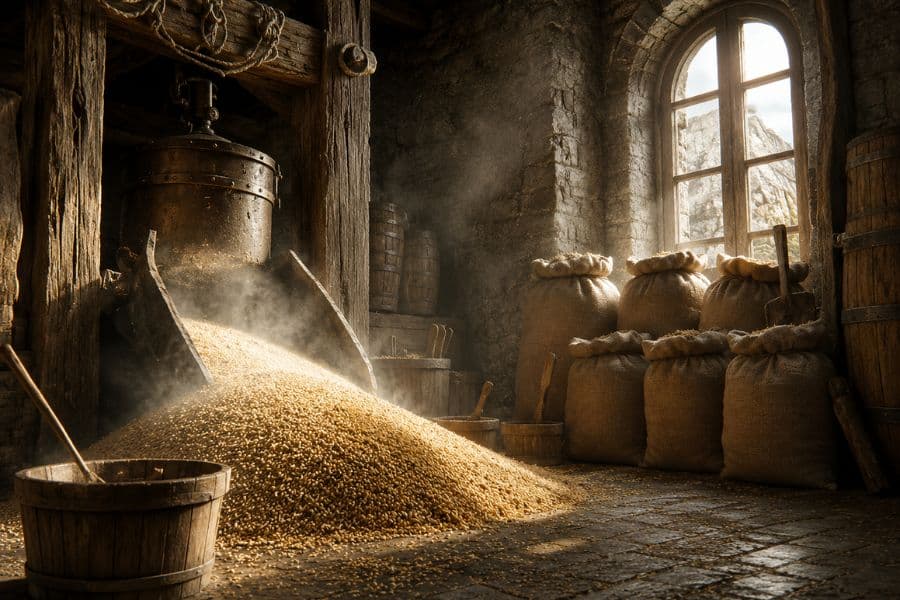
The lower rooms of a castle were the fridge before there were fridges. Thick stone walls, no direct sun, and a floor set into the earth kept a fairly steady temperature year-round, usually somewhere in the 50s Fahrenheit.
That’s roughly what a modern wine cave aims for, and it’s why so many French châteaux still use their old undercrofts to age cheese and bottles today.
A well-run 13th-century household stored salted pork, smoked sausage, cured hams, sacks of dried peas and lentils, wheels of hard cheese, apples packed in straw, and root vegetables buried in sand.
The steward’s job was to know exactly what was down there and how long it would last. Run out of salt beef in February and the whole garrison ate porridge until Easter.
At Château de Castelnaud in the Dordogne, you can still walk through the lower storage rooms and see the scale of it.
2. The Well and the Water Supply Everyone Depended On
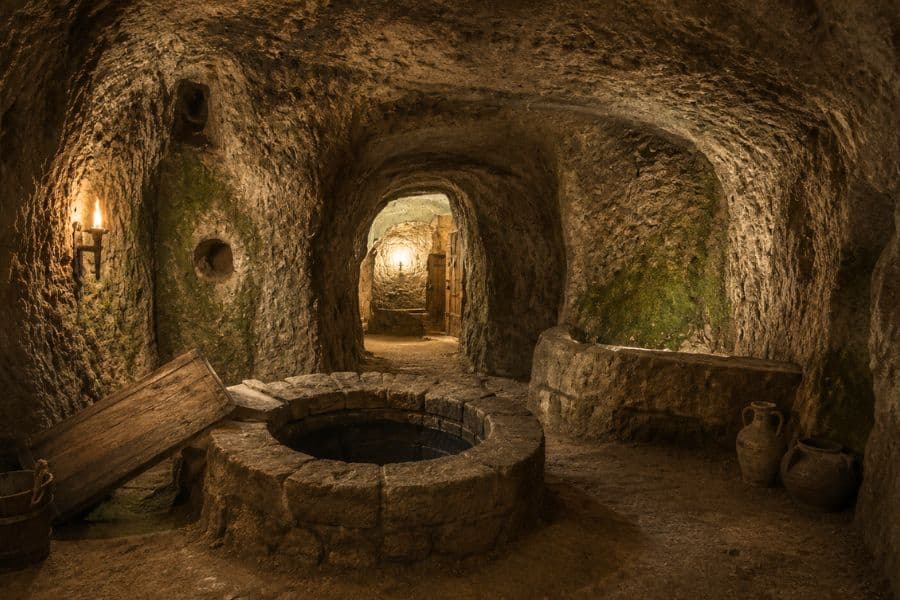
A castle without water was a castle that surrendered in a week. The well was usually sunk in one of the lowest rooms of the keep, sometimes right in the middle of the main hall’s undercroft, so it stayed inside the strongest walls and couldn’t be poisoned or cut off during a siege.
Some go astonishingly deep. The well at Château de Chinon drops around 260 feet through solid rock, dug by hand in the medieval period.
During the siege of Château Gaillard in 1203 to 1204, Richard the Lionheart‘s great fortress above the Seine, the defenders held out for months largely because they had secure water. When wells failed or were cut off from the outer bailey, castles fell fast.
3. Kitchens, Bread Ovens, and the Constant Business of Feeding People
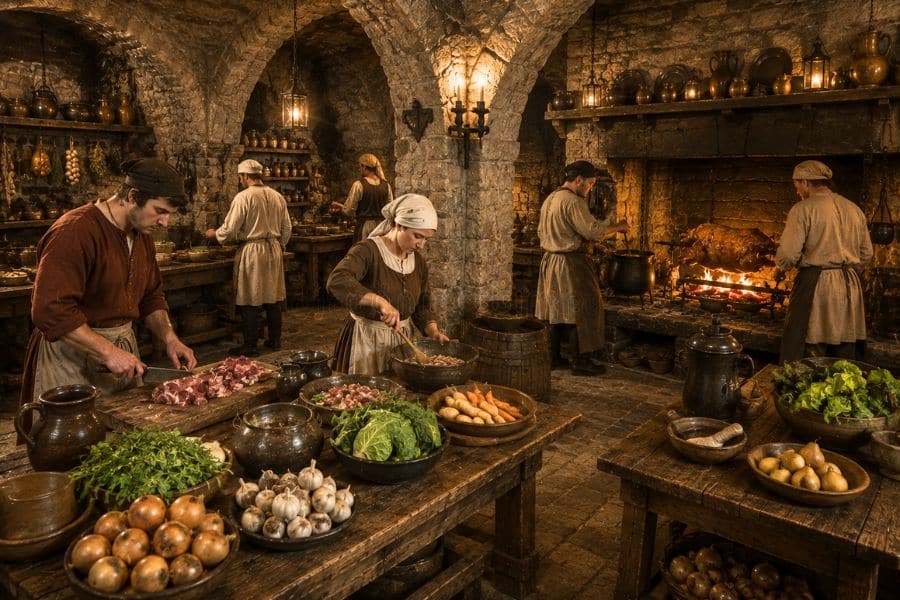
Cooking on that scale needed space, water, ventilation, and a floor that wouldn’t burn down when a spit dripped fat for six hours. The lower rooms delivered it all. Big castle kitchens were often on the ground floor or half-sunk into it, close to the well, close to the storerooms, and connected to the great hall above by a service stair.
A feast day meant roasting whole pigs, boiling cauldrons of pottage, baking dozens of loaves in a stone oven fired from before dawn, and butchering fresh meat on a table in the corner.
The bread oven alone was a serious piece of engineering. A dome of brick or stone that held heat for hours, big enough to bake 40 or 50 loaves at a time. Some castles had a second smaller oven for pastries and sauces.
Hooked on the Middle Ages? Get more stories like this one in your inbox.
4. Wine Cellars, Cider Presses, and the Brewhouse

In a country that ran on wine, the cellar was one of the most valuable rooms in the building. Barrels of local red for the household, better bottles for the lord’s table, casks of vinegar for cooking and preserving.
In apple country up north, cider took the same role, pressed and fermented in the lower rooms and drawn off through the winter. Water was often unsafe to drink straight, so weak ale, cider, or watered wine was the everyday drink for adults and children alike.
The cellarer was a serious job, sometimes held by a monk in monastic houses and by a trusted household officer in a lay castle.
They tasted, tracked, and topped up barrels, and were responsible for making sure the wine held up until the next vintage. A cellar that turned to vinegar in June was a small disaster.
5. Armories and the Working Storerooms of a Garrison
A castle was a barracks as much as a home. Somewhere in the lower rooms sat the armory, with racks of spears, crossbows, quarrels by the barrel, mail shirts oiled against rust, helmets, shields, and the tools to fix all of it.
A garrison of 30 men needed thousands of crossbow bolts to sit out a serious siege, and those bolts didn’t store themselves.
Alongside the weapons went the workshops. A castle smith, a fletcher making arrows, a leatherworker for straps and scabbards, sometimes a small forge tucked into a corner with its own chimney. These were noisy, sooty rooms, kept below the living quarters for obvious reasons.
6. Stables, Kennels, and Space for the Working Animals
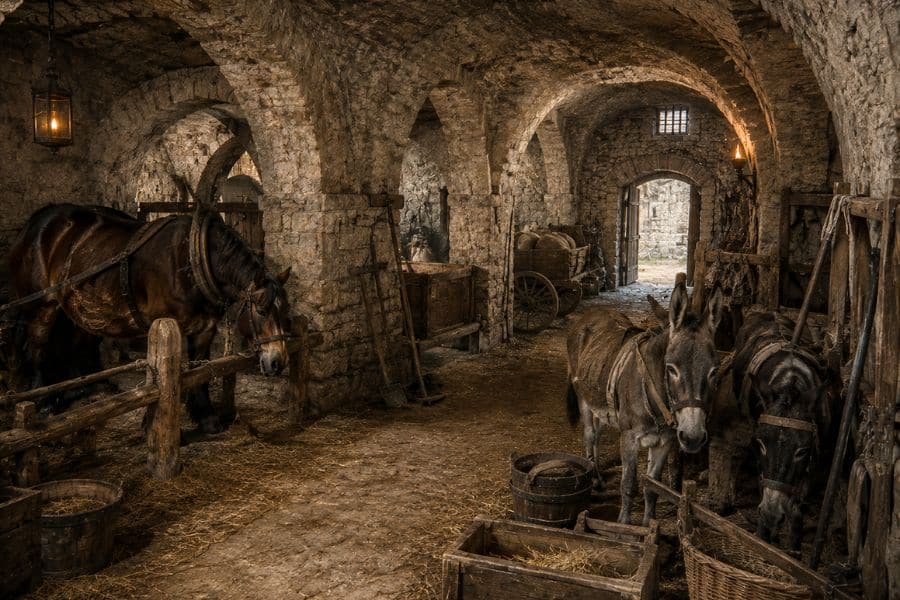
Horses were expensive and essential, and they lived on site. In smaller castles and tower houses, the ground floor often housed the stables directly, with the family living above on the first and second floors.
The animals gave off heat that rose through the timber floors and helped warm the hall in winter, which sounds unpleasant to modern ears but was completely normal at the time. The smell was the price of a warm bedroom.
Alongside the horses came the working dogs. Hunting hounds for the lord, guard dogs for the gate, terriers for the rats in the granary. Kennels were usually in the lower courtyard or a lean-to against the curtain wall, close enough for the huntsman to feed and manage them.
Hunting fed the household through winter and kept the lord’s men trained for war, so the kennels earned their keep.
7. The Guardroom and the Machinery of the Gate

Every castle gate was a small fortress in itself, and the lower room beside it was where the guards lived, ate, and slept in shifts. A fire in the hearth, a table, benches, weapons within arm’s reach, and a view of anyone approaching the drawbridge.
This was the room where a stranger arriving at the gate would be questioned, held, and either let through or sent packing.
Above or beside the guardroom sat the machinery. Windlasses to raise the drawbridge, chains to drop the portcullis, murder holes in the vault above the passage for pouring water on fires or dropping stones on attackers. All of it needed maintenance, oiling, and testing.
The gate crew did that work from the lower rooms, and any prisoner who did briefly end up locked in a castle was often held here for a night or two before being moved on, not in a purpose-built dungeon deep underground.

Love a good medieval story?
Join our readers and get tales of kings, queens, castles and ordinary medieval lives straight to your inbox.

Kylie Lang is a nationally syndicated travel journalist with bylines on the Associated Press Wire & more, a medieval history writer, and the founder and lead author of Tales of the Middle Ages (talesofthemiddleages.com). She holds a BA (Honours) in History from the University of Kent and is a member of the British Guild of Travel Writers.
Related posts:
 Which English Castles Are Worth Visiting for Medieval History?
 The Medieval Siege: What It Actually Took to Starve Out a Castle, and How Long People Could Hold On
 The Reality of Life in a Medieval Castle, the Sounds, Smells, and Struggles of Daily Life
 What Did Medieval Castles Actually Look Like Inside? (Not What You’re Imagining)