On the morning of 23 August 1485, the men who had ridden out of Leicester behind Richard III woke up to a world that had no place for them. Their king was dead, stripped naked and slung over a horse. The crown had been picked out of a thornbush and dropped onto the head of a Welsh exile whom most of them had never met.
What came next, for the knights, sheriffs, esquires, and household clerks who’d built their careers around the House of York, is the part that gets skipped. Bosworth ends the movie, and the credits roll while Henry Tudor rides off into the sunset to be crowned.
Table of Contents
But several thousand men had served Richard in some capacity, from the great northern lords down to the chamber servants who had laid out his shirts. Some were dead in the field, but the rest had to decide, quickly, what kind of Tudor subjects they were going to be.
The Dead and the Attainted
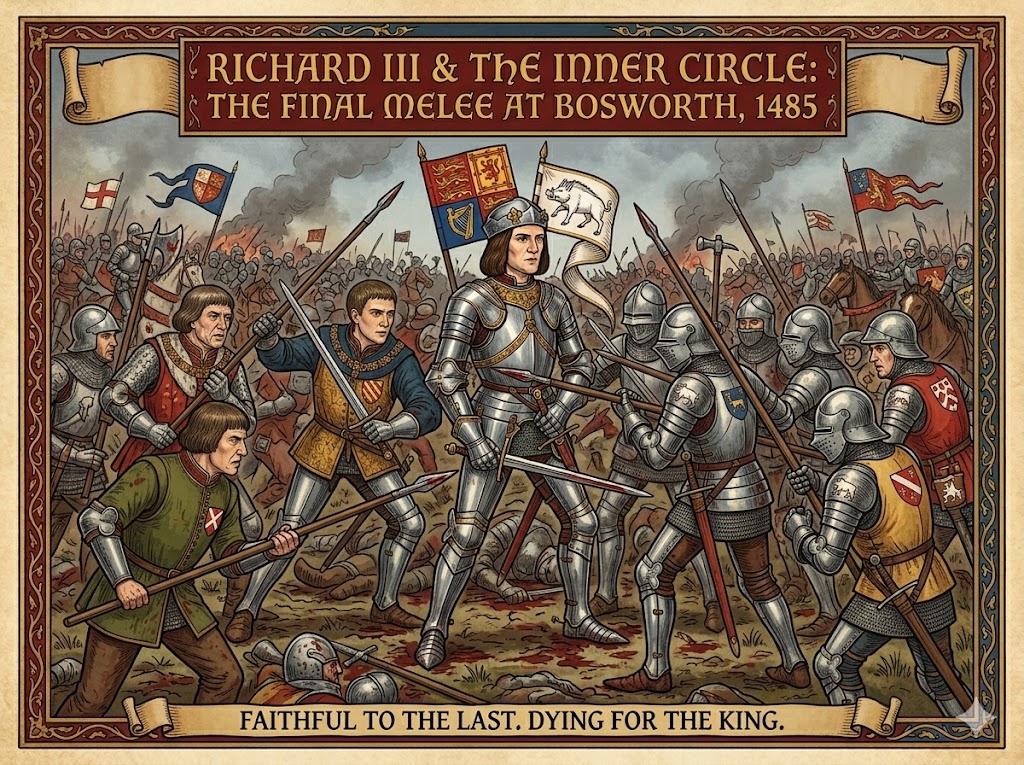
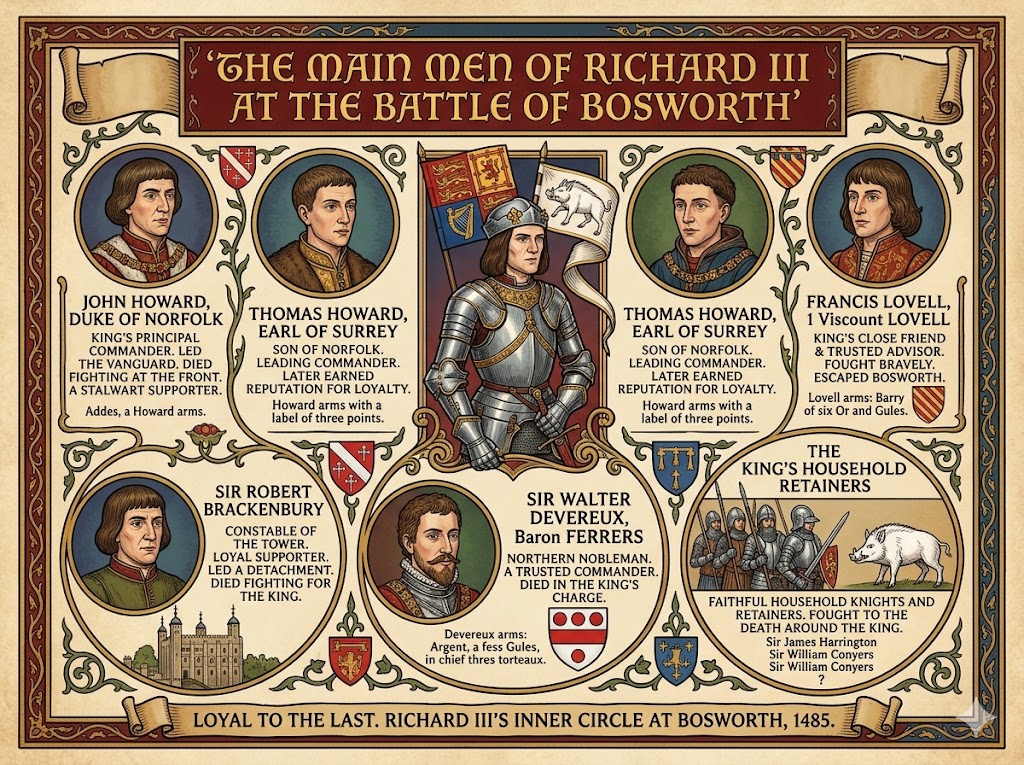
The killing at Bosworth was concentrated and personal. Richard’s final charge took down John Howard, Duke of Norfolk, who’d been one of the most committed Yorkists in the realm and had ridden out knowing the omens were bad.
A piece of doggerel pinned to his tent the night before warned him that Dickon, his master, was bought and sold. He went anyway. He died in the field along with Robert Brackenbury, the Constable of the Tower, and Richard Ratcliffe, one of the king’s closest northern men.
Henry’s first parliament, which met in November 1485, attainted twenty-eight of Richard’s supporters. Attainder was the legal sledgehammer of the period. It declared a man a traitor, stripped his heirs of land and title, and corrupted the blood, meaning sons and grandsons couldn’t inherit either.
The list included Norfolk, his son Thomas Howard, Earl of Surrey (who had survived the battle and was sitting in the Tower), Francis Lovell, William Catesby, and a string of others.
Catesby, the lawyer half of the Cat, the Rat, and Lovell, our Dog rhyme that had circulated about Richard’s inner circle, was captured at Bosworth and beheaded at Leicester three days later.
His will, written in those final hours, is one of the strangest documents of the period. He begged the Stanleys to help his wife and children, which is bleak given that the Stanleys had just helped kill his king. He also asked his executors to pray for the soul of King Richard, which took some courage to put in writing in August 1485.
Thomas Howard in the Tower
Thomas Howard’s story is the one I find myself coming back to whenever I think about how the Tudor regime actually consolidated itself. He’d fought for Richard at Bosworth, his father had died there, and his earldom of Surrey was stripped by attainder. By any reasonable expectation, he should have followed Catesby to the block.
Instead, Henry put him in the Tower and left him there for three and a half years. The story goes that during the Lambert Simnel rising in 1487, Howard’s jailer offered him a chance to escape and join the rebels. He refused, on the grounds that he’d sworn loyalty to whichever king sat on the throne, and the man on it now was Henry.
Whether the conversation happened exactly like that or not, the message reached Henry, who began the slow process of rehabilitating him.
By 1489, Howard was out, and his earldom restored. He spent the next decade and a half proving useful. He went north as Lieutenant in the King’s Absence, hammered the border, sat on commissions, and made himself indispensable.
In 1513, by then in his seventies, he commanded the English army at Flodden and destroyed James IV of Scotland and most of the Scottish nobility in an afternoon. Henry VIII gave him back the dukedom of Norfolk for it. The man who had fought for Richard III died a duke under the second Tudor, having outlasted almost everyone who had stood on either side at Bosworth.
Hooked on the Middle Ages? Get more stories like this one in your inbox.
Francis Lovell and the Men Who Wouldn’t Stop
Not everyone took the deal. Francis Lovell, Richard’s closest friend and Lord Chamberlain, had escaped the battle and taken sanctuary at Colchester Abbey. He came out in the spring of 1486 and tried to raise Yorkshire against Henry. It fizzled out.
Lovell slipped away to Flanders and the court of Margaret of York, Duchess of Burgundy, Edward IV and Richard III’s sister, who spent the rest of her life trying to put a Yorkist back on the English throne.
From Burgundy, Lovell threw himself into the Simnel plot. Lambert Simnel was a baker’s son being passed off as Edward, Earl of Warwick, the actual Yorkist claimant, whom Henry had locked in the Tower.
The conspirators landed in Lancashire in June 1487 with around two thousand German mercenaries and an Irish contingent, met Henry at Stoke Field, and lost. Stoke is usually called the last battle of the Wars of the Roses, because it killed off the last serious Yorkist field army.
Lovell vanished there. He may have died in the battle or escaped and drowned crossing the Trent.
There’s an old story, possibly an invention, that a skeleton was found in a hidden room at Minster Lovell Hall in 1708, sitting at a desk. No one’s ever been able to confirm it. What we do know is that he was never seen again, and a man who’d been one of the three most powerful figures in England under Richard III simply disappeared from the record at thirty-two.
The Pardoned and the Useful
For most of Richard’s servants, survival meant going to a sheriff or commissioner and submitting. Henry issued hundreds of individual pardons in the months after Bosworth, and their records are scattered through the patent rolls in a long, dull list that hides a thousand private negotiations.
A pardon usually cost money, sometimes a lot of money, and often came with conditions: bonds for good behavior, recognizances that could be called in if you stepped out of line.
This is where Henry was at his most effective. He didn’t need most of these men dead, just frightened, indebted, and watchable.
The bond and recognizance system, which he refined into something close to an art, kept the gentry of England on a financial leash for the rest of his reign. A man might be pardoned for serving Richard, then bound for a thousand pounds to keep the peace, then bound again on behalf of his neighbor. If he misbehaved, the crown collected. If he didn’t, the crown still held the paper.
Men like Sir Marmaduke Constable, who had been one of Richard’s commissioners in the north, slid into Tudor service almost without a pause. He was on Henry’s commissions of the peace by 1486. He commanded the left wing at Flodden in 1513 alongside Howard. His tomb at Flamborough has him in full armor, the inscription noting his service from Edward IV onward, three Yorkist kings and two Tudors, without missing a beat.
I’ve stood in that church. The brass is worn smooth by five centuries of feet, and there’s something about it that captures the whole period: a man who served whoever was on the throne, kept his head down, and died in his bed.
The Northern Affinity and What Was Lost
Richard had built his power base in the north, particularly in Yorkshire and the lordship of Middleham. The men who served him there had done so for nearly fifteen years, since Edward IV had set him up as Lord of the North in 1471.
When word of his death reached York, the city council wrote in their official record that King Richard, late mercifully reigning over us, was through great treason piteously slain and murdered, to the great heaviness of this city.
That was on 23 August, the day of the battle. It is one of the rawest things written about Bosworth, and it was set down by men who knew they were now writing to a new master.
The northern affinity didn’t recover. Henry distrusted Yorkshire for the rest of his reign and made a point of pulling its men south, marrying them off, putting them on commissions where their loyalties could be diluted.
The Council of the North, which had been Richard’s instrument, was reorganized under Tudor control. Some of Richard’s old retainers ended up serving it. Others quietly retired to their manors and never returned to court.
The human cost is hard to measure because it shows up in absences. A man who would have been knighted under Richard wasn’t. A son who would have inherited didn’t. The Harringtons of Hornby, who had backed Richard against the Stanleys in a long property dispute, lost out completely; the Stanleys, now Henry’s stepfather’s family, took everything.
I sometimes wonder how many private grievances were sitting in northern manor houses in the 1490s, polished and passed down, waiting for a son or grandson to act on them. The Pilgrimage of Grace in 1536 came partly out of that soil.
What the Choice Looked Like
Picture the calculation, if you were one of these men. You’re forty years old with a wife, four children, a manor, and tenants. You’ve sworn an oath to Richard, and Richard is dead. The new king is the grandson of a Welsh squire and a French dowager queen, with a claim to the throne so thin that Henry himself dated his reign from the day before Bosworth so he could attaint men for fighting against him on the day.
You could fight him, flee to Burgundy, and live on Margaret of York’s charity, or you could go home, pay the fine, sign the bond, and hope.
Most of them went home and paid. They served on juries and commissions, and watched their sons marry into Tudor-aligned families. Some of them, like Howard and Constable, ended up shaping the new regime so completely that by the 1520s no one remembered they’d started out as Richard’s men.
Others never quite came back. Their names drop out of the records around 1485 and don’t return.
A generation later, when Thomas Howard’s grandson stood trial for treason under Henry VIII in 1547, the family had been at the heart of Tudor politics for more than sixty years. The dukedom they’d lost at Bosworth had been won back at Flodden, lost again to attainder, and would be won back again under Mary.
The white boar badge had been put away, and in its place stood the silver lion of Howard, an older symbol, one that predated the choosing of sides. It turned out you could survive almost anything in Tudor England if you were willing to be useful and willing to forget.
Love a good medieval story?
Join our readers and get tales of kings, queens, castles and ordinary medieval lives straight to your inbox.

Kylie Lang is a nationally syndicated travel journalist with bylines on the Associated Press Wire & more, a medieval history writer, and the founder and lead author of Tales of the Middle Ages (talesofthemiddleages.com). She holds a BA (Honours) in History from the University of Kent and is a member of the British Guild of Travel Writers.
Related posts:
 The Queen Who Blew Up the Tudor Court: Catherine Howard’s Rise and Catastrophic Fall
 September 4, 925: The Day England’s First King, Æthelstan, Was Crowned, But Was He?
 Sweyn Forkbeard: The First Viking King of England
 The Battle of Poitiers: The Black Prince’s Boldest Victory and the Capture Of a French King