We all love a good movie set in the Middle Ages, and although we’ve had a few medieval TV series recently, it’s been a while since we had a movie, and I’m excited.
And the topic is brand new. We’ve not had a film specifically about the English Peasants’ Revolt of 1381 led by Wat Tyler, so it will be interesting to see how true to history it is.
Table of Contents
The cast is a stellar one, and with Paul Greengrass writing, producing and directing, we could be in for a treat.
It hits theaters on September 11, so not long to wait, and the perfect way to welcome in the cooler Autumn months.
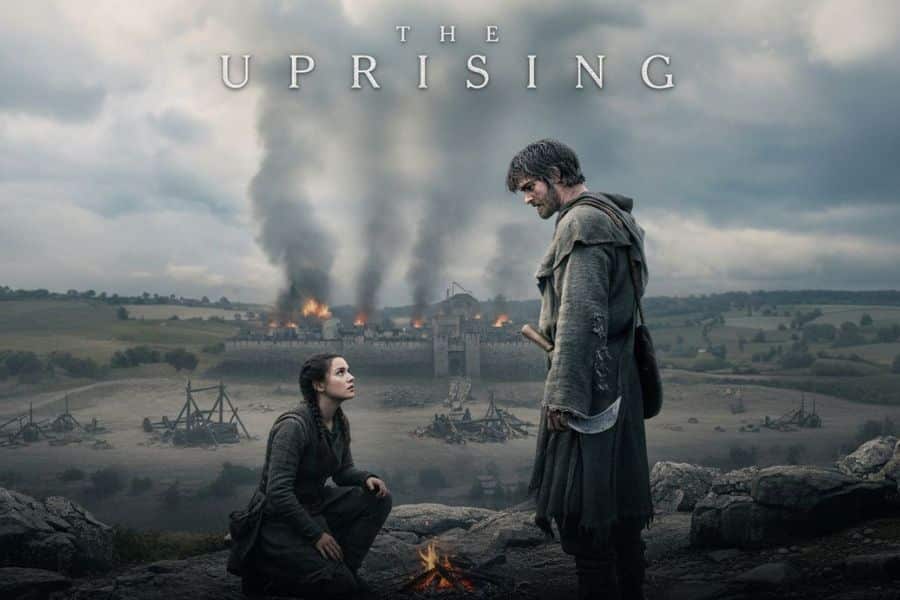
The Uprising Trailer
The Plot
Andrew Garfield plays the leader of a rebellion against King Richard II. War is burning across England, taxes are crushing the ordinary population, and he raises what the film calls an army of the people to march against the crown. Justice and survival, in that order.
Wat Tyler was the man who led the peasant army out of Kent in the summer of 1381, into London, and up to the walls of the Tower itself. If you know your Peasants’ Revolt, you know how that ended for him. I won’t spoil it here in case the film takes an unexpected turn.
What struck me while watching the trailer is how muddy, cold, and physical it looks. Greengrass has never been one for gilded, polished medieval fantasy. His camera stays close, sweaty, and jostled, and it looks like he’s brought that same instinct to the 14th century.
The Historical Moment It’s Drawing On
The Peasants’ Revolt sits in one of the darkest decades of English history, and the film sets itself squarely in the middle of it. The Black Death had ripped through England starting in 1348 and returned in waves through the 1360s and 1370s.
Whole villages emptied out. Labor became scarce and workers, for the first time in generations, had a bit of leverage over the landowners.
The crown didn’t like that one bit. The Statute of Laborers had already tried to pin wages back to pre-plague levels. Then came the poll taxes to fund Richard II’s end of the Hundred Years’ War against France, and the third, levied in 1380, was the match to the tinder.
A flat tax of a shilling per adult, in a country still reeling from decades of death, was more than most rural households could carry. Collectors were sent out to enforce it. In Essex and Kent, the collectors got a very unfriendly reception.
What followed was one of the largest popular uprisings in English medieval history. Tens of thousands marched on London in June 1381. They burned the Savoy Palace, dragged the Archbishop of Canterbury out of the Tower and beheaded him on Tower Hill, and confronted the 14-year-old king in person at Smithfield. Richard, extraordinary boy that he was, rode out to meet them.
Tyler was killed in the meeting, likely by the Mayor of London, and Richard is said to have talked the rest of the rebels down with promises he never intended to keep. The reprisals that followed were savage.
Hooked on the Middle Ages? Get more stories like this one in your inbox.
Andrew Garfield in the Lead
Garfield has two Oscar nominations, a range that runs from Spider-Man to tick, tick… BOOM! to that heartbreaking turn in We Live in Time opposite Florence Pugh. He’s also just come off After the Hunt, and he’s next up in The Magic Faraway Tree with Claire Foy, which already opened in the UK and reaches US theaters on August 21.
Casting him as the leader of a peasant army is a smart move. He has that thing certain actors have where you believe he’s furious and grieving at the same time, and 1381 was a story soaked in both.
The peasant leaders weren’t drawn from the aristocracy. They were tilers, tradesmen, men from small towns who’d buried too many family members and paid too many taxes and finally said no. Garfield can carry that without turning it into a superhero pose, and I’m curious to see him do it.
He’s also physically right for the part. Tyler and the men around him were not enormous, well-fed knights. They were ordinary bodies pushed to an extraordinary act. Garfield reads as an ordinary man, which is the highest compliment I can pay a leading actor in a film like this.
The Supporting Cast
The list of names attached to this film is pretty impressive. Jamie Bell, whom I’ve loved since Billy Elliot. Stephen Dillane, forever Stannis Baratheon to a certain generation, and one of the best stage actors of his generation.
Tom Hollander, who can play menacing and comic in the same breath. Cosmo Jarvis, fresh off Shogun, where he was extraordinary. Thomasin McKenzie, Jonny Lee Miller, Woody Norman, Katherine Waterston, and Sky Yang round out what’s been announced.
I’ve no idea yet who’s playing Richard II, who’s playing John of Gaunt, or who’s stepping into the shoes of the Archbishop, but with Dillane and Hollander on the call sheet, someone is about to have a very bad day at Smithfield.
Films this stacked can end up with half the cast doing 90 seconds of screen time and vanishing. But Greengrass tends to use his ensembles well. With this bench, he has room to draw the entire social hierarchy of 1381 England, from the peasant leadership up through the royal council, and I hope that’s what he’s done.
Paul Greengrass and What He Brings
Greengrass wrote the script as well as directed and produced it, and that tells you something about how personal this is for him. He’s the man behind two of the Jason Bourne films, Captain Phillips, Green Zone, News of the World with Tom Hanks, and 22 July, his hard-to-watch account of the Utoya attacks in Norway.
He was Oscar-nominated for United 93, which handled the September 11 hijacking of that flight with more restraint and honesty than anyone had a right to expect.
His last project was The Lost Bus with Matthew McConaughey and America Ferrera, a disaster thriller about the Camp Fire in California. I don’t think he’d have signed on to a medieval film unless he saw something in 1381 that spoke to the present.
Tax revolts, popular anger at distant elites, a young ruler surrounded by advisors who can’t read the room. Take from that what you will.
The producing team behind him includes Jason Blum, of Blumhouse fame, as well as Gregory Goodman, Joanna Kaye, Joe Neurauter, and Lars Sylvest. Blum on a Greengrass historical is an interesting pairing, because Blumhouse usually operates in horror, and it suggests this film may have been made lean and fast, the way Blum likes to work. That’s often a good sign for the finished product.
Circle September 11 in Your Calendar
The film opens on September 11, 2026. I’ll be booking a ticket for the first showing I can get to when I’m next in the UK, and if you have any interest at all in medieval England, in Andrew Garfield doing his best work, or in a director who takes real events seriously without dressing them up, this one’s worth putting in your diary.
I’ll report back once I’ve seen it, muddy field by muddy field.
Love a good medieval story?
Join our readers and get tales of kings, queens, castles and ordinary medieval lives straight to your inbox.

Kylie Lang is a nationally syndicated travel journalist with bylines on the Associated Press Wire & more, a medieval history writer, and the founder and lead author of Tales of the Middle Ages (talesofthemiddleages.com). She holds a BA (Honours) in History from the University of Kent and is a member of the British Guild of Travel Writers.
Related posts:
 15 Medieval Movies to Watch if You Love History, the Middle Ages and Being Transported to Another Era
 8 Movies About Real Medieval Queens (and How Much They Got Right)
 What Was Daily Life Like for a Peasant Woman in the Middle Ages?
 The Story of Katherine Swynford: How a Knight’s Widow Became the Ancestor of Every English Monarch Since Henry VII