At Valley Forge in the winter of 1777, a soldier with dysentery had two hopes of surviving. The first was that the bloody flux would pass on its own. The second was that a woman would come by his hut with a kettle, clean rags, and the willingness to handle whatever was coming out of him.
There were thousands of these women in the Continental Army. They cooked, nursed, scrubbed lice out of shirts, hauled water, sewed cartridges, and on a few documented occasions picked up a rammer and worked a cannon. Washington’s official correspondence is full of them, usually in the form of complaints about how many there were and how to keep them out of sight.
Table of Contents
Can you imagine what it would have been like to have been one of those women? It makes me appreciate all that I have in my life. So who were these women, and how did they come to be there in the first place?
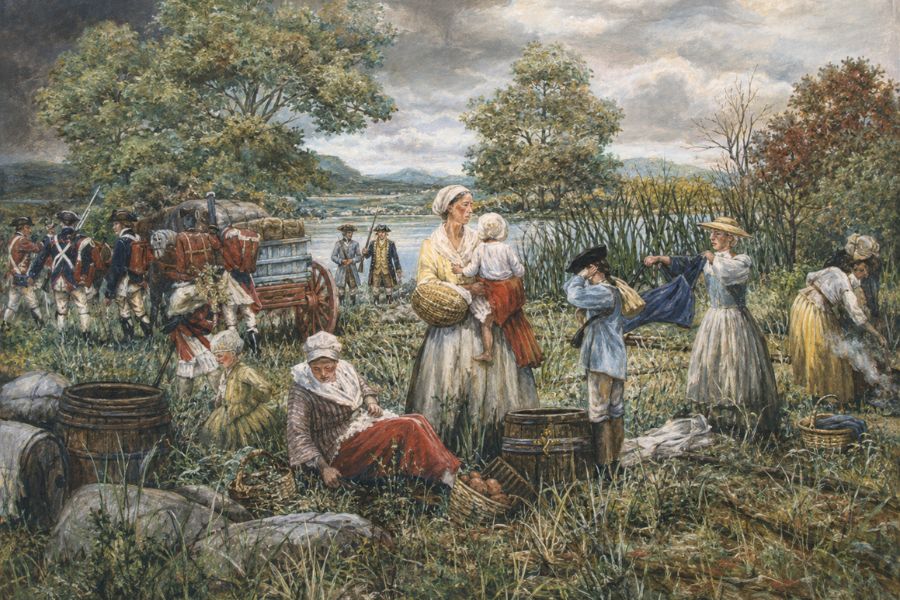
Who Followed the Army, and Why
The numbers shift depending on the campaign, but by 1777, Washington’s army of around 11,000 men was trailed by something like 400 to 500 women on the official ration rolls, and probably more who weren’t counted.
At points during the war, the ratio ran closer to one woman for every 10 to 15 soldiers. They brought children with them, too, as it was common for whole families to live in the camps.
Most were the wives, sisters, and daughters of enlisted men, and they followed for the same practical reason poor women have always followed armies. If your husband enlisted for the duration and you had no land, no income, and no household to keep, staying behind meant starving.
Following him meant a half ration and a roof of canvas, which was better than nothing. Some were widows of men who had died in service, others were runaway indentured servants, and a smaller number were enslaved women who had attached themselves to the army for the same reason.
Washington’s general orders are full of grumbling about them. He called the women a ‘clog’ on the army’s mobility, ordered them out of the wagons, forbade them from riding when soldiers were on foot, and tried more than once to limit how many could draw rations. He never actually got rid of them, because he couldn’t.
An army that size needed the labor they provided, and the alternative, hiring civilian contractors at every halt, was impossible in a country at war with itself.

The Work That Kept the Army From Rotting
Laundry sounds like a domestic afterthought until you remember what an 18th-century military camp smelled like. Men wore the same wool coat and linen shirt for weeks and were a breeding ground for lice. Typhus, which is carried by body lice, killed more soldiers in the Revolution than musket fire did. A woman with a kettle of lye and boiling water was, in real terms, a public health intervention.
The army paid washerwomen by the piece, and the rates were fixed in general orders. At Valley Forge, a woman could earn a few shillings a week scrubbing shirts in freezing creek water, with her hands cracked open to the knuckle. She also drew a ration for herself and a half ration for each child. It was brutal work, and it was the difference between a regiment that could march and a regiment confined to its huts with fever.
Cooking was the other constant. Soldiers were issued raw flour, raw beef, and dried peas, and were expected to figure out the rest themselves. In practice, the women in each mess cooked for groups of men, turning the ration into something edible. Nursing fell to them, too.
Field hospitals at Bethlehem and Reading during the Valley Forge winter were staffed in large part by army wives who emptied chamber pots, changed dressings on amputations, and sat with men dying of camp fever. Dr. James Tilton, who ran several of these hospitals, wrote bluntly that without the women, the sick would have lain in their own filth.

Valley Forge From the Cook Fire
The winter of 1777 to 1778 is the part of the Revolution everyone knows in outline. About 12,000 soldiers in log huts, snow, no shoes, Baron von Steuben drilling them in the spring. What gets left out is that several hundred women wintered there too, in the same huts, on shorter rations, doing the work that kept the camp from collapsing into a typhus pit.
Martha Washington came up from Mount Vernon in February and stayed until June. She organized sewing circles among the officers’ wives, mended shirts and knitted stockings for the enlisted men, and visited the sick.
Lucy Knox and Catharine Greene, wives of the artillery and quartermaster generals, did the same. Their work was visible because they were officers’ wives, and someone wrote it down. The hundreds of other women at Valley Forge are mostly nameless in the record, showing up only as ‘women of the army’ in ration returns.
Try to picture doing laundry there. You’re breaking ice off the surface of a creek to get to the water, you’ve got chilblains on every finger, and there’s a soldier two huts over who needs his shirt back by morning because it’s the only one he has. That was the job, every day, for five months.
Around 2,000 soldiers died at Valley Forge that winter, mostly of disease. Without the women doing what they did, the number would have been catastrophically higher.
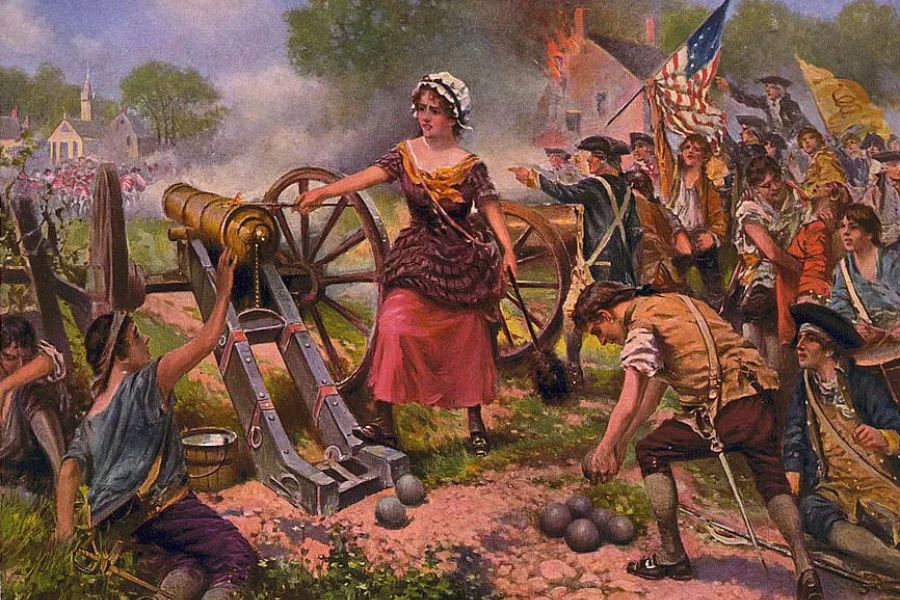
Brandywine, Monmouth, and the Women Under Fire
Camp followers were supposed to stay behind the lines, but the lines in an 18th-century battle were never as clean as the maps suggest. Women carried water to the gun crews, who needed it constantly to swab out the barrels between shots and to drink in the heat.
Pitcher duty put them inside artillery range, which is how the legend of Molly Pitcher came to exist. The Molly Pitcher of folklore is a composite, but the women behind her are documented.
Mary Ludwig Hays was at Monmouth in June 1778 with her husband, an artilleryman in the 4th Pennsylvania. By multiple eyewitness accounts, she carried water to the gun crew through the afternoon in temperatures over 100 degrees, and when her husband was wounded or fell from heat exhaustion, she took his place at the cannon.
Joseph Plumb Martin, a private who was there, later wrote that a cannonball passed between her legs and tore away part of her petticoat, and she looked down, made a remark about it being lucky it hadn’t passed higher, and went back to her work.
Margaret Corbin was at Fort Washington in November 1776 when the Hessians overran the position. Her husband was killed at his cannon, and she took over, firing it until grapeshot tore up her chest, shoulder, and jaw. She survived, partly. She lost the use of her left arm for the rest of her life.
In 1779, Congress voted her a lifetime pension at half a soldier’s pay, the first woman in American history to receive one. She drew it until her death in 1800, by which point she was, by all accounts, a profane and difficult woman who drank too much and got into fights, which I completely understand.
Sarah Osborn was at Yorktown in 1781, cooking for soldiers and carrying beef, bread, and coffee up to the lines under fire. In her pension application 50 years later, sworn in 1837 when she was in her eighties, she described Washington himself asking her whether she was afraid of the cannonballs.
She told him the bullets wouldn’t cheat the gallows. It’s the kind of line you couldn’t make up, and historians haven’t, because it sits in her own sworn testimony in the National Archives.
Washington’s Quiet War Against Their Visibility
Washington’s attitude toward the women in his camps was a working contradiction. He needed them, but he also wanted them invisible to civilians, who he worried would see the army as a disorderly mob trailing wives and children rather than a respectable national force.
The army was political theater as much as it was a fighting body, and the women complicated the image he wanted to project.
When his army marched into Philadelphia in August 1777 in a parade meant to impress the civilian population, his orders were specific. The women of the army were to take a side route through back streets and rejoin the column outside the city.
A French officer noted dryly that the women still managed to be seen, marching with stolen umbrellas and children on their hips, and that the effect was less stately than the commander had hoped. Washington tried the same maneuver at later parades with similar results.
After 1832, when Congress finally extended pensions to surviving veterans and their widows, women like Sarah Osborn, Rachel Wells, and dozens of others filed sworn depositions describing what they had done during the war.
The depositions are blunt, specific, and full of detail. They named regiments, officers, battles, and the work they did. They were old women by then, mostly poor, and they were asking for a few dollars a year to live on. Many were denied. Some, like Osborn, were approved and lived out their last years on six dollars a month.
The Revolution they had kept alive in 1777 paid them back in 1840, when there was almost nothing left of them to pay.

Related posts:
 Vera Atkins, Legendary Spymaster of the SOE Turned Nazi Hunter
 The Medieval Siege: What It Actually Took to Starve Out a Castle, and How Long People Could Hold On
 The Ones That Got Away. The Six Women Who Kept Their Heads, By Not Marrying Henry VIII
 Violette Szabo: The Young Mother Who Became Britain’s Most Decorated Spy