
They said she died on the rope that day in Edinburgh. A crowd gathered in the Grassmarket to see justice done, to watch the body swing and the lesson sink in. When the bell rang and the trap gave way, everyone thought it was over. The officials did their job, the coffin was nailed shut, and the cart rolled out of the city. But somewhere along that quiet road to Musselburgh, death lost its grip.
The story of Margaret Dickson, the woman Scotland came to call Half-Hangit Maggie, is one of law, punishment, and survival in a world that left little mercy for women who stepped out of line. What happened to her in 1724 raised questions the courts could barely answer and left the public both thrilled and unsettled.
Table of Contents
Before the legend, there was a woman. Before the nickname, a rope. And what came after changed more than just one life. So who was Half-Hangit Maggie and what on earth happened to her?
Who was Margaret Dickson, Half Hangit Maggie?
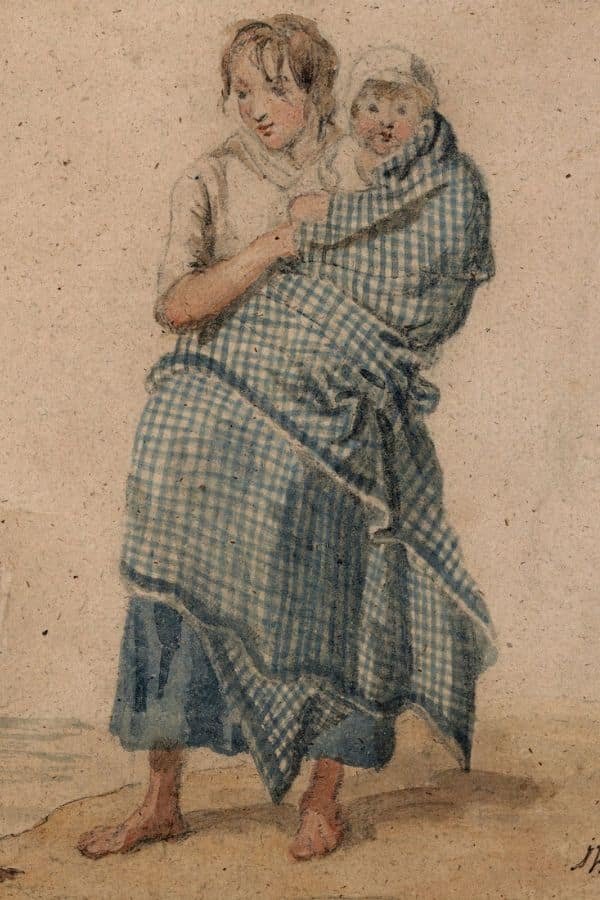
In the small Scottish town of Musselburgh, just east of Edinburgh, lived a young woman named Margaret Dickson. She worked as a fishwife, earning her keep along the coast and in the markets. Like many women of her class, she had little money, few legal rights, and a reputation to protect in a world quick to judge.
After her husband left her, Margaret took a job at an inn near Kelso. Away from home and desperate to keep working, she began a relationship with a man there and soon became pregnant. In 18th-century Scotland, for an unmarried woman to have a baby could mean the loss of work, home, and dignity.
She concealed her pregnancy, likely terrified of what would happen if anyone found out. When the baby was later discovered dead near the River Tweed, suspicion fell immediately on her. She was arrested and taken to Edinburgh, where the courts were swift and unforgiving. Whether the child had been stillborn or not made little difference under the law of the time. Margaret was found guilty and sentenced to hang.
What happened next would turn her into one of Scotland’s most talked-about figures, a name still spoken three centuries later.
The Charge, Conviction, and Execution
When the body of a newborn was discovered near the River Tweed in 1724, suspicion quickly fell on Margaret Dickson. She had been working at an inn near Kelso, far from her home in Musselburgh, and rumors of a concealed pregnancy had already begun to circulate.
At the time, Scottish law treated the concealment of a pregnancy as a serious offense. A woman whose baby was found dead could be presumed guilty of murder unless she could prove the child was stillborn. For someone like Margaret, who was poor and uneducated, providing that proof was almost impossible.
She was taken to Edinburgh and put on trial. Despite a lack of clear evidence that the child had lived, she was convicted. The sentence was death by hanging at the Grassmarket, the city’s public place of execution.
On September 2, 1724, the crowd gathered in the Grassmarket to see Margaret’s sentence carried out. Executions were public events then, drawing merchants, children, and gossip. The condemned were paraded through the streets, often made to pray and confess before the noose was fixed.
Margaret’s hanging followed the usual grim ritual. The rope tightened, the platform dropped, and her body was left hanging long enough to be declared dead. When the executioner cut her down, she was placed in a simple wooden coffin and loaded onto a cart for the journey back to Musselburgh.
There was no priest, no burial procession, and no ceremony. Her body was just another reminder of the law’s reach in a society that rarely forgave women who broke its moral code.

Hooked on the Middle Ages? Get more stories like this one in your inbox.
What Happened After the Execution
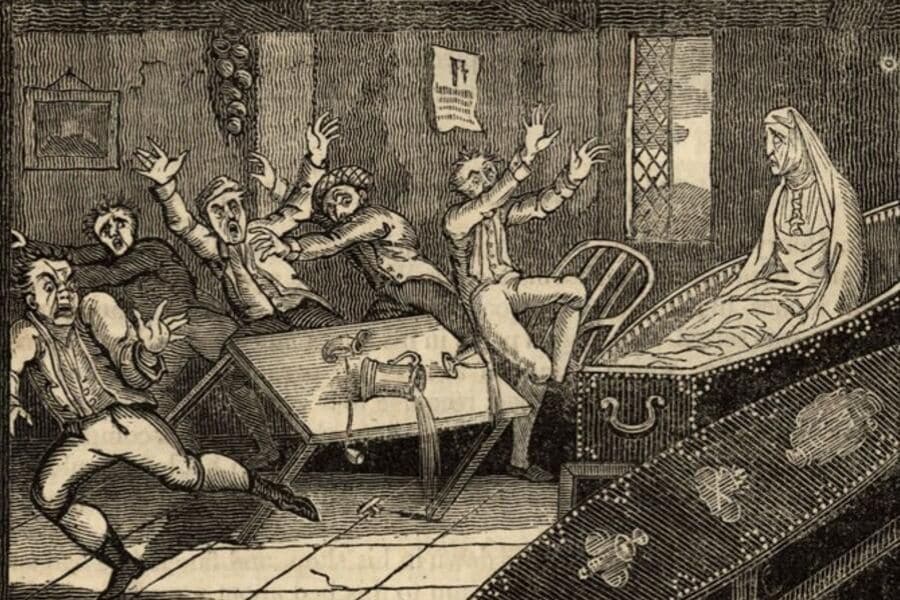
Somewhere along the road to Musselburgh, the story took an extraordinary turn. The men escorting the coffin stopped at a roadside inn, possibly near Duddingston, when they heard movement inside the box. At first, they thought it was their imagination. Then came a faint knock.
When they pried open the coffin, Margaret Dickson was breathing. Weak, pale, but alive. It seemed a miracle. But the truth likely lay in the crude method of hanging used at the time. The short-drop system strangled rather than broke the neck, and it was possible to survive if the rope didn’t tighten correctly or the person lost consciousness rather than dying outright.
Word of her survival spread quickly through Edinburgh and beyond. Crowds came to see her, and the courts faced an unexpected question: could a woman be punished twice for the same crime? The answer was no. The law had been carried out, and Margaret had paid her price. She was free to live.
When she returned to Musselburgh, her husband reportedly took her back, and they lived together for many years. Locals called her “Half-Hangit Maggie,” a nickname that stuck long after her death. The tale became part of Scottish folklore, retold in taverns and newspapers, a story that blurred the line between justice, luck, and something far stranger.
The Press Surrounding Maggie
In the early 1700s, Scotland’s public loved a good scandal. The growing trade in printed broadsides, cheap, single-sheet news sheets sold on street corners, fed that appetite perfectly. Printers across Britain churned out ballads, lurid crime reports, and sensational “true” stories faster than they could be read.
Words like murderer, monster, and abomination filled the pages. She was described as a woman consumed by sin, her fall from grace treated as both warning and entertainment. One broadside poem, titled A Warning to the Wicked, or, Margaret Dickson’s Welcome to the Gibbet, declared:
“Ignorance, the Source of all our Evil,
Made her a faithful Factor to the Devil:
For when the Heart’s not bolted against Sin,
It lets the Devil and Damnation in.”
The Kirk and local authorities also played their part. They published “confessions” in the voices of convicted women, long and moralizing pieces that publicly displayed their supposed repentance. They reinforced the Church’s authority and justified harsh punishment.
Many of these documents were signed not by the women themselves, but with an X and the phrase her mark, revealing that most couldn’t read or write. They had no say in what was printed beneath their names.
Margaret’s own so-called confession was one of these. She couldn’t have written it, yet a five-page document bearing her name survives. In it, she claims her husband left her with several children and that she was later impregnated by William Bell, the son of the innkeeper where she worked.

The text suggests the encounter may not have been consensual. She says she told him about the pregnancy but received no help, so she hid it from everyone else. The child, she said, was stillborn.
That admission fills only a small part of the text. The rest is pages of heavy-handed repentance, filled with religious guilt and endless warnings against sin. Whether Maggie said any of it is unclear. Perhaps she described the facts, and the church added the moral preaching later.
What’s certain is that nowhere in the document does she admit to killing her baby. She confessed only to concealing the birth. Yet under the law of 1690, that alone made her a murderer.
A month after her trial, the Caledonian Mercury reported her execution on September 3, 1724:
“Yesterday, Margaret Dickson suffered in the Grass-market, pursuant to the sentence emitted against her for the murder of her own child. She was cut down some time after thrown over, and put into a bier, in order to be transported to Musselburgh, to be buried with her people.”
The Rumored Fight Over Her Body
One version of Margaret Dickson’s story claims her body nearly never made it to the coffin. According to later accounts, a group of anatomy students tried to seize it at the gallows, hoping to use it for dissection. Public executions were sometimes followed by such scuffles, as medical schools often struggled to find enough bodies for study.
In this version, friends and townspeople fought to keep her remains from being taken, winning back her coffin before it was carried off to Musselburgh. It’s a vivid image that’s appeared in broadsides and retellings for centuries.
But modern research from the Surgeons’ Hall Museum in Edinburgh casts doubt on that story. Scotland’s first formal medical school didn’t open until 1726, two years after Margaret’s hanging. The organized scramble for bodies, which later became the trade of grave robbers and anatomy students, came decades later.
The Law That Ensnared Her
In 1724, Scottish law left little room for mercy. The statute that sealed Margaret Dickson’s fate had been in force for more than thirty years.
The 1690 Act “Anent Murdering of Children”
Passed by the Scottish Parliament in 1690, the Act “anent murdering of children” presumed a mother guilty of murder if she concealed her pregnancy and the child was later found dead or missing. There didn’t need to be signs of violence. The mere act of hiding the birth was seen as proof of intent to kill.
The law was rooted in moral judgment as much as justice. It aimed to punish “secret births” and discourage infanticide, but offered little chance for women to defend themselves. Poverty, shame, and the rigid expectations of the time meant many ended up condemned by circumstance rather than evidence.
It was under this harsh law that Margaret was charged and sentenced to hang.
Repeal and Replacement in 1809
More than eighty years later, public opinion and legal reform finally caught up. The 1690 Act was repealed and replaced by the Concealment of Birth (Scotland) Act of 1809. This new legislation no longer treated concealment as murder but as a lesser crime punishable by imprisonment rather than death.
While the wording has been revised over time, elements of that 1809 act still exist in modern Scottish law.
Why She Was Not Hanged Again
When Margaret Dickson miraculously revived after her execution, the courts faced an unprecedented question. Could she be hanged a second time? The answer, under Scots law, was no. The sentence had been carried out.
The principle of double jeopardy protected her from being punished twice for the same crime. Folklore adds that judges began including the phrase “to be hanged until dead” in future death sentences to prevent such a situation from happening again. There’s no formal record of that wording being introduced specifically because of Margaret, but the claim has persisted through the centuries as part of her legend.

Love a good medieval story?
Join our readers and get tales of kings, queens, castles and ordinary medieval lives straight to your inbox.

Kylie Lang is a nationally syndicated travel journalist with bylines on the Associated Press Wire & more, a medieval history writer, and the founder and lead author of Tales of the Middle Ages (talesofthemiddleages.com). She holds a BA (Honours) in History from the University of Kent and is a member of the British Guild of Travel Writers.