Living in France, you can’t go a mile without finding a market. It’s fab! You could, quite literally, go to a different market every day of the week to buy your fresh produce if you so desired. I go twice a week as I just love the community around them, chatting with the vendors and stopping for a cup of coffee in the square after I’ve finished shopping.
Markets and fairs in medieval times weren’t that much different. They served as the economic lifeblood of communities across Europe, a medieval version of Amazon or Facebook marketplace. But with one big difference.
Table of Contents
These gatherings were as much about the social side as they were about buying goods. They were social spectacles that fostered community spirit, cultural exchange, and economic growth. It was a form of entertainment in a time when there was no internet, Netflix, or video games.

The Origins of Medieval Fairs
The roots of medieval fairs can be traced back to ancient times, with early versions emerging from Roman markets. However, it was during the Middle Ages, particularly from the 12th to the 15th centuries, that fairs flourished in Europe. The term “fair” itself derives from the Latin word feria, meaning a holiday or festival. Many fairs were held in conjunction with religious feast days, making them significant cultural events as well.
Life in the Middle Ages was tough. Travel was slow, local shops weren’t really a thing, and most people lived their entire lives within a few miles of where they were born. If you needed something beyond what your village could make or grow, you were out of luck. That’s where the fair came in.
As many of the fairs were tied to religious festivals, their popularity grew. Churches drew crowds, and where there were crowds, there was money to be made. Smart move, really. A holy day became a chance to buy things you couldn’t otherwise get your hands on, salt, spices, fine cloth, iron tools. Some fairs even offered banking services and contracts, especially the big ones. You’d turn up for a saint’s feast and leave with a new pair of boots and maybe a loan agreement.
As towns grew and trade expanded, local lords began granting charters that allowed towns to hold annual fairs. This practice became widespread in England and France, with many towns vying for the right to host these lucrative events. By the 13th century, fairs had become essential components of medieval commerce, attracting merchants from far and wide.
One of the earliest and most influential examples was the Champagne Fairs in what’s now northeastern France. They were major international events, drawing merchants from as far as Italy, Flanders, and the Middle East. People planned their trade routes around them. They lasted for weeks and were fiercely organized. Deals struck at the Champagne Fairs could shape prices across Europe.

The Structure of Fairs
Medieval fairs were surprisingly organized. They had to be. You can’t run an event that pulls in hundreds, sometimes thousands, of people from across the region without a solid system.
First off, the location mattered. Most fairs were held in or near towns that already had a bit of infrastructure, a church, some basic lodging, a central square or open field. Town leaders or landowners set up booths, stalls, and temporary shelters for traders. In bigger fairs, areas were divided up by trade. You might find all the cloth merchants in one row, food vendors in another, livestock sellers somewhere with space (and preferably downhill). This made it easier to manage money and disputes.
Security was another big deal. People brought serious wealth, such as gold coins, goods worth a fortune, horses, spices, and even jewels. Towns often stationed guards at the fairgrounds and around the town perimeter to protect traders. Some even set up makeshift courts right there at the fair to settle arguments on the spot. If two merchants got into a dispute about a shipment of wool, they didn’t have to wait for a town judge. There was someone on hand to sort it out then and there.
Even the layout had a logic to it. Entry points were watched, often with tolls. Towns made a tidy profit just by charging for space, safety, and access. Some of that money went back into the fair, but a lot padded the pockets of whoever held the rights, usually the church. You could always tell who was in charge by who sat in the raised booth near the entrance, keeping an eye on the flow of traffic.
Vendors and Goods
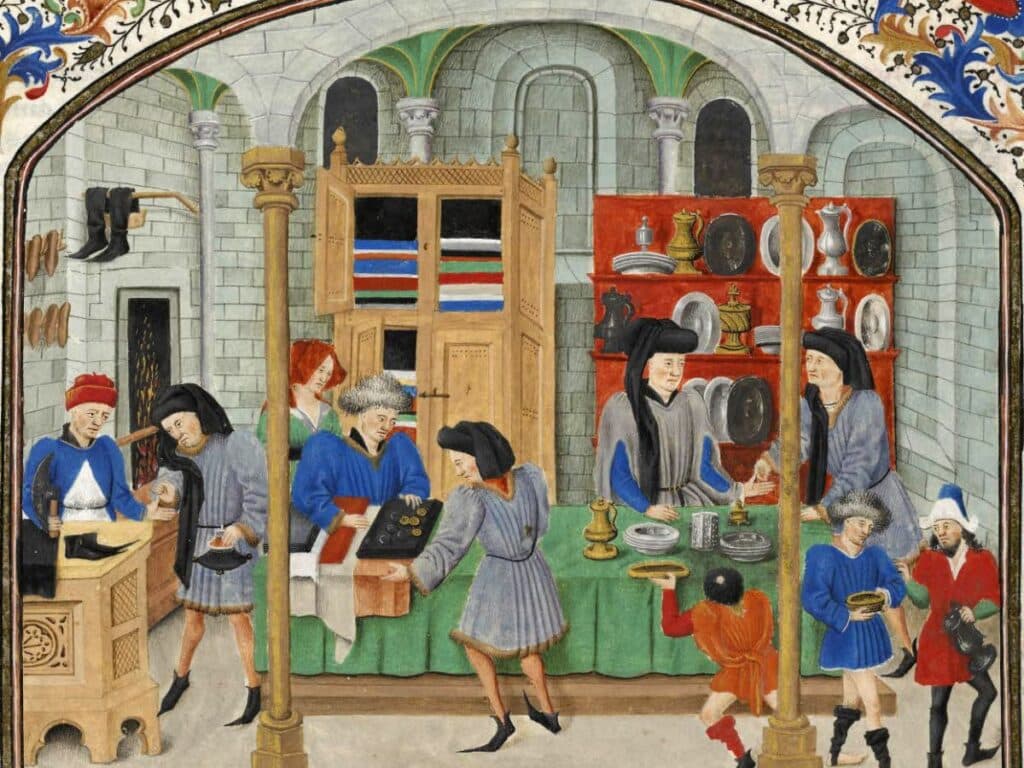
If you’d wandered through a medieval fair, the first thing to hit you wouldn’t be the crowds or the clamor, it would be the smell. Spices, sweat, livestock, baked goods, damp wool, wet hay, and maybe a waft of something brewing or fermenting. It was a full-on sensory overload, and that was part of the appeal.
Fairs were a magnet for merchants of every kind. You had local farmers with carts of turnips and onions set up right next to foreign traders offering fine silks or dried figs from who-knows-where. There were spice sellers with tiny packets worth more than a laborer’s monthly wage. Wool merchants from England. Wine from the Loire. Sacks of salt that could preserve meat through winter. If it could be bought or bartered, you’d find it here.
Then there were the craftspeople. Cobblers who could fix your boots on the spot. Tanners hawking leather belts and bags. Smiths forging tools or repairing a broken buckle while you waited. Some set up small workstations under canvas awnings, hammering away while customers watched.
And don’t forget the entertainers. They weren’t technically vendors, but they earned their keep all the same. Jugglers, musicians, puppet shows, fire-eaters. They played to the crowd, passed a hat, and hoped enough people were in a generous mood.
A fair was hard work, but it was also a rare day of fun. For people who spent most of their lives farming or laboring, this was a chance to be dazzled for a few minutes and maybe forget how hard life really was.

Legal Framework
Running a fair without rules would have been chaos. With traders traveling hundreds of miles, bringing goods worth a small fortune, everyone needed to know where they stood. That’s where the legal side of fairs came in.
It started with the fair charter. This was an official document granted by a king, noble, or church authority, giving permission to hold the fair and setting out the rights that came with it. That charter was gold. It meant legal protection. It meant the right to collect tolls. It often meant the fair was tax-free for a set time, which pulled in traders like moths to a flame.
The charter set the rules. It named the fair’s dates, who was in charge, and what kind of justice system applied. Weighing and measuring was a major sticking point. Merchants were required to use standard weights, which were often inspected by local officials. Cheat the scales, and you could be fined or kicked out.
Repeat offenders might have their goods confiscated or worse. In some towns, if you were caught selling rotten meat or watering down your wine, public punishment followed, which often meant a stint in the stocks. That kept most vendors honest.
There were also rules about who could sell what and where. Some stalls were reserved for locals. Others were rented out for a fee, with the best spots going to the highest bidder or to traders with a long-standing relationship with the town. Competition could get fierce. Turf disputes weren’t uncommon, especially when profits were on the line.

Hooked on the Middle Ages? Get more stories like this one in your inbox.
The Economic Impact of Fairs
You can’t overstate how important fairs were to the economy. For a lot of towns, they were the biggest payday of the year. Fairs brought in outside money. That alone was a game-changer. When merchants from other regions rolled in, they needed food, lodging, repairs, horseshoes, ale, maybe a place to stable their animals. Local inns filled up. Farmers sold off surplus. Craftsmen got extra work. Even beggars and pickpockets had a bumper week.
But the ripple effect didn’t stop there. A successful fair could put a town on the map. Literally. Look at places like Provins or Troyes in France. They didn’t start out as major centers, but once their fairs gained a reputation, trade routes shifted to pass through. Roads improved. Storage warehouses were built. Banking systems followed.
Once that network started growing, it gave local people access to goods and opportunities they’d never had before. Some of the bigger fairs ran for weeks. They had staggered markets for different types of goods. One week for textiles, another for livestock, another for luxury items. That stretched the economic benefit over time and gave everyone a slice of the pie.
Over time, the biggest fairs became hubs for long-distance trade. You’d see Italian merchants setting up deals with Flemish cloth makers. Northern European fishmongers cutting agreements with southern salt dealers. These weren’t small-time sales. These were bulk deals that influenced pricing across entire regions. Some of the earliest forms of credit, insurance, and written contracts were forged in these kinds of settings.

Social Aspects of Fairs
For most people in the Middle Ages, life was painfully repetitive. Wake up. Work. Eat what little you had. Sleep. Repeat. Days blurred into weeks, and seasons measured the rhythm of survival. But then the fair came to town. And just like that, everything shifted.
A fair was a chance to step outside the grind. The moment the carts started rolling in, the atmosphere changed. Noise, color, smells, and energy filled the streets. For locals, it meant something to look forward to. For travelers, it was a break from endless roads and empty fields. People put on their best clothes. They gathered in the square. They watched, listened, flirted, argued, and haggled. It was messy, loud, and more importantly, fun.
There were performances in the open air. Minstrels playing music, storytellers spinning tales, and acrobats who balanced on ropes or danced with fire. For people who’d never seen a cathedral or a city, this was their theater, their gallery, their show.
And because these fairs pulled in people from far and wide, they weren’t just local affairs. They became melting pots. You’d hear unfamiliar accents, see foreign dress, maybe even try food you’d never tasted. People from different regions traded not only goods but also stories, gossip, and knowledge. News from distant places traveled faster at a fair than it ever could through church sermons or town criers.
And then there was love. Or at least the medieval version of it. Fairs were prime spots for courting. Young people from neighboring villages finally had a chance to meet, and with all the excitement, people were bolder than usual. Some came home with a new belt or blanket. Others came home with a future spouse.
But even if no purchases were made and no deals were struck, just being there was enough. Because when life was ruled by the same fields, the same routines, and the same worries day after day, the fair gave people permission to break free. To laugh. To dance. To taste something new. And for a few brief days, to remember that there was more to life than just getting through it.
Conclusion: The Legacy of Medieval Fairs
We don’t think twice now about buying something online or checking out a new seller from the other side of the world. But back then, the fair was the platform. It was where goods moved, reputations were built, and deals were done face to face. Not with a click, but with a handshake. Sometimes a fistfight.
Medieval fairs laid the groundwork for the way we trade today. They were the testing ground for early credit systems, legal frameworks, and commercial networks. Today’s online marketplaces like Amazon echo many aspects of medieval fairs: they connect buyers with sellers across vast distances while providing platforms for diverse goods ranging from everyday necessities to luxury items.
Love a good medieval story?
Join our readers and get tales of kings, queens, castles and ordinary medieval lives straight to your inbox.

Kylie Lang is a nationally syndicated travel journalist with bylines on the Associated Press Wire & more, a medieval history writer, and the founder and lead author of Tales of the Middle Ages (talesofthemiddleages.com). She holds a BA (Honours) in History from the University of Kent and is a member of the British Guild of Travel Writers.