In the early 900s, the Franks had a Viking problem. Specifically, a Rollo problem. This towering warlord from Scandinavia had spent years raiding up and down the Seine River, burning villages, pillaging monasteries, and generally making life miserable for everyone in northern France.
King Charles the Simple watched his treasury drain while the Vikings kept coming back for more. By 911, both sides were exhausted. The Franks couldn’t get rid of Rollo, and Rollo was smart enough to know that endless raiding wasn’t a sustainable business model.
Table of Contents
What Rollo wanted was legitimate land he could rule, farm, and pass on to his descendants. Charles, realizing that fighting was a losing game, had an idea that was to change history.
Rollo of Normandy: The Viking Who Wouldn’t Bend
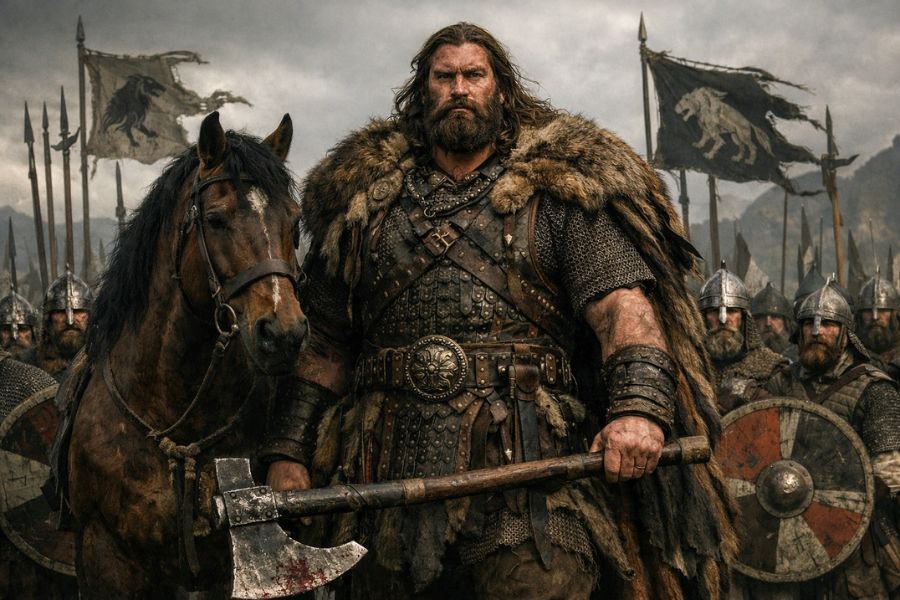
Nobody knows exactly where Rollo came from. Some sources say Norway, others say Denmark. What we do know is that he earned the nickname “Rollo the Walker” because the man was so massive that no horse could carry him. His weight would break the animal’s back. Can you imagine someone that large?
By 911, Rollo had already made a name for himself. He was prominent among the Vikings who besieged Paris in 885 and 886, and by the turn of the century, he’d established a permanent settlement along the Seine River in 900. For King Charles, who had been crowned in 898, this permanent Viking presence was relatively peaceful at first. The real problems started in 911 when Rollo resumed raiding.
Rollo was a strategic warrior, understanding that you could only burn and pillage the same territory so many times before there was nothing left worth taking. What he wanted was a place where his men could settle down, raise families, and build something that would last. He just needed someone to legitimize that claim. Enter Charles the Simple, a king desperate enough to try anything.

The Siege of Chartres: When Everything Changed
In June 911, Rollo laid siege to Chartres. The city held out, and on July 20, a Frankish relief army arrived to confront the Vikings. The Bishop of Chartres led a counter-attack, brandishing religious relics like weapons, rallying his troops with the promise of divine protection.
By nightfall, Rollo and his men were trapped on a hill north of the city, taking heavy losses. It was a defeat, but not a crushing one. Rollo’s forces were weakened but still formidable, still dangerous, still camped on Frankish soil with nowhere else to go.
Charles the Simple looked at the situation and made a calculation. He’d won the battle, but he couldn’t win the war. Vikings had been raiding Francia since the time of Charlemagne. King after king had tried to stop them, and king after king had failed. The treasury was empty from paying tribute, and the people were exhausted. Here was Rollo, beaten but unbroken, with an army that could still tear through the countryside if they wanted to.
So Charles made a decision that would change the course of European history. Instead of trying to destroy Rollo, he would make Rollo his ally. He would give him land, legitimacy, and a title in exchange for peace and partnership.
The Treaty: How to Give Away a Kingdom
The Treaty of Saint-Clair-sur-Epte was negotiated in the aftermath of Chartres. The location was chosen carefully, halfway between Paris and the coast in the region of Neustria. Charles proposed that Rollo would get a massive territory from the River Epte to the sea. In exchange, he would convert to Christianity, swear fealty to Charles, and defend the Seine estuary from other Viking raiders. Essentially, Charles was hiring a Viking to fight Vikings.
Charles initially offered Rollo a stretch of rocky, marshy coastline in northern Francia. Rollo took one look at it and said no. He wanted farmable land, something that could actually support his people and produce wealth.
So Charles quickly revised the offer, suggesting the land east of the Epte River along the northern coast. This territory was far more fertile, with rich soil and access to trade routes. This land would later become known as Normandy, the land of the Northmen.
Charles sweetened the deal even further by offering Rollo his daughter Gisela in marriage. At least, that’s what the chronicles say. The truth is, historians still argue about whether Gisela even existed. If she did, she was probably one of Charles’s illegitimate daughters, and she would have been somewhere between three and four years old at the time of the wedding.
Most sources agree that if the marriage happened, Gisela died young and childless. Rollo’s real partner was a woman named Poppa of Bayeux, who bore him his son William Longsword, the future Duke of Normandy.
The Foot-Kissing Incident: Viking Pride Meets Frankish Protocol
The ceremony to seal the Treaty of Saint-Clair-sur-Epte followed standard Frankish tradition. Rollo was expected to place his hands between the king’s hands, swearing vassalage. Then came the final gesture of submission, stooping down and kissing King Charles’s foot, following the normal protocol.
Every vassal kissed their lord’s foot as a sign of respect and acknowledgment of authority. But protocol doesn’t mean much to a Viking warlord who’s spent his entire life taking what he wants by force. To Rollo, kneeling before another man and kissing his foot violated everything he believed in, not to mention being humiliating in his eyes. Norse culture valued independence, strength, and personal honor above all else. Submission was for the conquered, not for the conquerors.
According to the chronicles, Rollo’s response was calm and matter-of-fact. “I will never bow my knees at the knees of any man, and no man’s foot will I kiss.”
The attending bishops urged him to reconsider, but instead, Rolloe looked at one of his warriors and gave him a simple instruction. You do it. The warrior stepped forward, but instead of kneeling, he grabbed King Charles’s foot, lifted it to his own head height, and planted a kiss on it while remaining standing.
In doing so, he yanked the king completely out of his chair. Charles went sprawling backward, robes flying everywhere, arms flailing, landing flat on his back in front of his entire court.
The Frankish nobles were horrified. This was their king, lying on the ground like a fool while Vikings stood over him laughing. The Vikings thought it was the funniest thing they’d ever seen, and Charles, to his credit, pretended not to be upset.
He picked himself up, straightened his robes, and carried on with the ceremony as if nothing had happened. At the end of the day, the treaty was more important than his dignity, and he was fully aware that he needed Rollo more than Rollo needed him.
That awkward, undignified moment sealed one of the most important political deals of the Middle Ages.

What Happened Next: Vikings Become Normans
In 912, Rollo was baptized in Rouen Cathedral, taking the Christian name Robert after his godfather, Robert I, Marquis of Neustria. And Rollo kept his word. He didn’t just take the land and continue raiding; he actually defended the region from other Vikings.
He restored churches that had been burned to the ground, established laws based on Norse concepts of personal honor and individual responsibility, rebuilt cities, extended fortifications, and created a functioning government.
His men settled down, married local women, learned to speak French, stopped worshiping Norse gods, and converted to Christianity. Within a single generation, Rollo’s Vikings stopped being Vikings, adopting the language, customs, and culture of Francia. They became Normans.
This cultural transformation happened faster than anyone expected. The Norse settlers intermarried with the Frankish population, creating a hybrid culture that combined Viking military prowess with Frankish administrative systems. The region flourished. Trade increased, and agriculture expanded. And there are no records of any more Viking raids on Francia after 911. Rollo had succeeded where Frankish kings had failed for generations. He’d ended the Viking age in northern France by turning Vikings into Frenchmen.

The Legacy: From Viking Raid to English Throne
Rollo ruled Normandy until his death around 933. His son William Longsword succeeded him, and the dynasty continued to grow in power and influence. Rollo’s grandson became Richard I, also known as Richard the Fearless; his great-great-great-grandson became Richard II, and Richard II’s grandson became the most famous Norman of all time.
William, Duke of Normandy. Later known as William the Conqueror.
In 1066, exactly 155 years after that foot-kissing ceremony, William invaded England. King Edward the Confessor had died without an heir, and William claimed Edward had promised him the throne. Harold Godwinson, the powerful Earl of Wessex, had been crowned king instead. William assembled a fleet of around 600 ships, crossed the English Channel with approximately 7,000 men, and landed at Pevensey on September 28.
On October 14, 1066, William’s forces met Harold’s army at Hastings. The battle lasted all day and was exceptionally bloody even by medieval standards. Harold was killed, either by an arrow to the eye or by Norman soldiers in the final assault. The English fled. William marched to London, and on Christmas Day 1066, he was crowned King of England in Westminster Abbey.
The Norman Conquest changed everything. The English language absorbed thousands of French words, Norman architecture replaced Anglo-Saxon buildings, and the feudal system was imposed across England with Norman nobles controlling vast estates. The church was reorganized under Norman bishops. Even English names changed, with William, Robert, and Richard replacing traditional Anglo-Saxon names.
But Norman influence didn’t stop with England. Norman adventurers conquered Sicily and southern Italy, establishing the Kingdom of Sicily. They played crucial roles in the Crusades and helped establish the Principality of Antioch. Norman administrative systems, military tactics, and legal codes spread across Europe. All of this traced back to that deal in 911, to that moment when Charles the Simple decided to make a Viking his vassal.