
Legends in the Middle Ages shaped dynasties, justified power, and sometimes destroyed reputations. One of the most enduring was the story of Mélusine, a woman said to have been part human and part serpent, who married into the noble House of Lusignan in France. Her story was written down in the late fourteenth century, but its roots run much deeper, back to the watery spirits that haunted European folklore.
Mélusine was tied to castles, families, and a bloodline that reached into the heart of medieval politics. Lords pointed to her as their ancestor to strengthen their authority, while enemies later used the same legend to paint women in their line as dangerous or unnatural. It was a double-edged sword, a myth that built legacies and whispered suspicion in the same breath.
Table of Contents
Centuries after Mélusine’s story first appeared, her name surfaced in England during the Wars of the Roses. Jacquetta of Luxembourg, mother of Elizabeth Woodville, was said to be descended from her. When political rivals needed ammunition, they twisted that connection into accusations of witchcraft.
The Beginning of the Mélusine Story
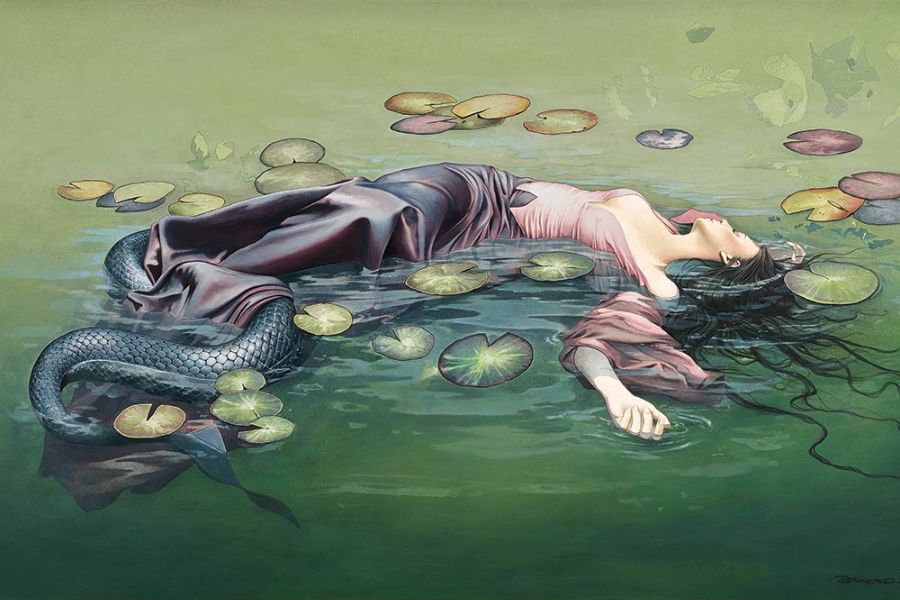
At its heart, Mélusine is a water spirit. Every culture in medieval Europe had them. They were women tied to rivers, lakes, or springs, often half-human and half-something else. Sometimes fish, sometimes serpent, sometimes winged. These figures gave blessings or curses, brought wealth or disaster, and nearly always carried a condition or taboo.
Scholars trace Mélusine’s shape back to the ancient idea of the fée des eaux, a fairy of the waters. In Celtic traditions, rivers and springs were thought to have female guardians. Archaeological finds show offerings of coins and jewelry thrown into wells and pools across Gaul and Britain, left for these spirits.
Later, Christianity tried to smother these figures under saints and holy wells, but the women in the water never went away. They simply changed form, slipping into local tales as seductive maidens or dangerous wives.
Raymondin in the Forest
Raymondin, a young nobleman of Poitou, was out hunting with his uncle, Count Aymeri of Poitou. In the chaos of the chase, Raymondin’s spear struck his uncle by accident, killing him. With no way to explain himself and terrified of vengeance, Raymondin fled into the woods.
That’s where he came across a woman by a spring. She was Mélusine. She offered him something no desperate fugitive could refuse: she would secure his inheritance, bring him wealth, and make him lord of vast lands. There was only one condition. If he married her, he must give her complete privacy every Saturday and never attempt to see her on that day. Raymondin agreed.
The bargain worked. With Mélusine at his side, Raymondin’s fortunes turned. Castles began to rise at astonishing speed. Mélusine was credited with building the fortress of Lusignan in just fifteen days. Other fortresses and churches sprang up across the landscape, said to be her handiwork. Wherever she went, stone walls followed, and people whispered that she used supernatural means to shape the very land.
A Family of Power and Secrets
Mélusine and Raymondin had many children, sometimes counted as ten, sometimes more, depending on the version. Their sons were powerful, but not all of them were born whole. Some carried marks that linked them back to their mother’s hidden form.
One had a single large tooth. Another bore a hairy ear. Yet another had eyes set too deep. These physical traces reminded listeners that Mélusine’s blood was not entirely human.
Still, the family thrived. Sons became dukes, knights, and even kings. The Lusignan name spread across France and beyond to the Crusader states. For medieval audiences, the message was clear. Mélusine’s bargain had worked. She had created a dynasty.
Broken Promise, Broken Spell
Of course, the secret could not hold forever. Whispers grew, and suspicion gnawed at Raymondin. Why must his wife vanish every Saturday? At last, he broke his vow. In one version, he drilled a hole in the door and spied on her bathing. In another, he simply barged in. What he saw changed everything. From the waist down, his wife’s body became a coiled serpent’s tail beneath the water.
Raymondin kept the secret for a time, but anger loosened his tongue. During a quarrel, he publicly accused her of being a serpent, betraying the trust that had bound them. The spell shattered. Mélusine let out a cry, transformed into a winged dragon, and fled. She never returned as a wife, but her presence was not gone.

The Dragon of Lusignan
From that day, Mélusine became something else entirely. Whenever a member of the Lusignan family died, she was said to appear above the castle of Lusignan, circling the towers in dragon form and screaming in the night. People in the surrounding countryside swore they heard her cries before the death of a lord or a great calamity. For them, Mélusine was no longer a hidden fairy wife. She was a death omen, tied forever to the fate of a dynasty.
It explained sudden deaths and shifting power. It bound the Lusignan name not only to the glory of castles and conquests but also to the dread of loss. Mélusine was both founder and curse, a mother of kings and a dragon that never let her descendants rest.
Hooked on the Middle Ages? Get more stories like this one in your inbox.
The Medieval Books That Made Her Famous
By the late 14th century, the story of Mélusine had caught the attention of powerful patrons who wanted it written down, polished, and preserved. Around 1393, Jean d’Arras, a writer at the court of Jean, Duke of Berry, was asked to put the legend into prose. The Duke was the son of King John II of France, brother of Charles V, and one of the richest men in the kingdom.
His court was steeped in art and literature, commissioning manuscripts that are still counted among the greatest treasures of the Middle Ages. The Mélusine story fit perfectly into this culture of genealogy, myth, and prestige.
Jean d’Arras produced what became known as the Roman de Mélusine. He wove it into a sweeping dynastic romance that connected Mélusine directly to the noble House of Lusignan. By claiming descent from a supernatural woman, the Lusignan family gained a pedigree that set them apart. Mélusine was not just a curious myth anymore; she was written into the family’s bloodline.
Not long after, another poet, Coudrette, created his own version of the tale in verse, known as the Roman de Partenay. His version leaned more heavily into moral lessons and the dangers of betrayal, while still celebrating Mélusine as a builder and a mother of kings. Together, these two works ensured that the legend spread far beyond Poitou.
Lavishly illustrated manuscripts of the Roman de Mélusine survive today. In them, Mélusine appears in two striking forms: the noble wife and mother, and the half-serpent bathing in secrecy. Later, early printers in the 15th and 16th centuries seized on the tale. As printing spread, so did Mélusine. She moved from aristocratic libraries into wider circulation, becoming part of Europe’s shared mythological imagination.
From Poitou to Plantagenets
The Lusignan family anchored Mélusine’s story in their castle, their heraldry, and their chronicles, but the legend didn’t stay locked in Poitou. As the Lusignans married into other noble houses and extended their reach through the Crusades, the claim of descent from Mélusine spread with them.
By the 14th and 15th centuries, the Mélusine story slipped into broader genealogies that tied European houses together. Writers and chroniclers weren’t shy about stretching bloodlines to make a point. A connection to Mélusine could give a family a sense of destiny, linking them to both miraculous creation and ominous prophecy. Even if no one could prove it, the suggestion was enough to color reputations.
This is how the legend made its way north, into the lines of Luxembourg, and eventually into England. Through these connections, Mélusine was no longer just the fairy wife of Poitou but an ancestress claimed by families whose descendants would sit on the English throne. By the time of Jacquetta of Luxembourg in the 15th century, the story of Mélusine was a piece of dynastic baggage, heavy with both prestige and suspicion.
Enter Jacquetta of Luxembourg
Through the House of Luxembourg, Mélusine’s legend crossed into England. Jacquetta of Luxembourg, born in the early 15th century, was part of this line and carried the claim of descent from the serpent-woman of Poitou. For her family, that ancestry was a mark of distinction, linking them to a founder who built castles and shaped dynasties.
In England, however, the story carried a different weight. Mélusine was not only remembered as a builder and mother but also as a dragon-omen tied to secrecy and curses. When Jacquetta rose to prominence at the English court, her enemies twisted that heritage into suspicion. They pointed to the Mélusine connection as proof that her bloodline was tainted with something unnatural.
The same legend that once strengthened a dynasty in France now marked Jacquetta as a dangerous figure. Her supposed descent from Mélusine became another weapon used against her in a world where myth and politics were impossible to separate.
Visiting the Landscape of the Legend
The best place to begin tracing Mélusine’s footsteps is still Lusignan in Poitou. The family castle she was said to have raised in just fifteen days once towered over the town. Though Louis XIII ordered its demolition in the 17th century, fragments of walls and terraces survive. Stand on the remains and you can see why people believed a supernatural builder shaped them.
But Mélusine’s legend didn’t stop at Lusignan. Across western France, towns claimed a piece of her story, each attaching her name to their stones. In the Vendée, an hour from where I live, the medieval town of Vouvant tells its own version. Locals say Mélusine built the fortified town walls and the great keep that still dominates the skyline.
According to the tale, after Raymondin betrayed her secret, she fled in dragon form and cursed the castles she had built. At Vouvant, Pouzauges, Tiffauges, Mervent, and Châteaumur, people believed her cry could still be heard, and that the stones of her castles would one day crumble to dust because of her curse.
In this version, Mélusine is tied even more closely to the land. Each fortress in the Vendée was marked as hers, each ruin a reminder of both her power and her fury. Walking through Vouvant today, you can still see the mighty tower attributed to her, known as the Tour Mélusine. It stands as the last trace of her legendary building spree, its survival lending weight to the idea that myths and stone can be bound together for centuries.
For travelers in the region, these places offer more than medieval ruins. They are landscapes where folklore and history overlap, where the serpent-woman of Poitou is not just a figure in a romance but a presence people once swore they heard in the night.

Love a good medieval story?
Join our readers and get tales of kings, queens, castles and ordinary medieval lives straight to your inbox.

Kylie Lang is a nationally syndicated travel journalist with bylines on the Associated Press Wire & more, a medieval history writer, and the founder and lead author of Tales of the Middle Ages (talesofthemiddleages.com). She holds a BA (Honours) in History from the University of Kent and is a member of the British Guild of Travel Writers.