You hear a lot of talk about royal families being inbred, usually with a snigger. But one dynasty took it so far that they quite literally bred themselves out of existence.
The Habsburgs built their empire not by war but by marriage, then spent two hundred years marrying their own nieces and cousins to keep that empire in the family. Over time, this concentrated their inherited flaws to a dangerous degree, leaving the final Spanish king, Charles II, with an inbreeding score as high as a child born to a brother and sister.
Table of Contents
He was disabled, infertile, and when he died childless in 1700, the great Spanish line of the Habsburgs died with him.
The Family That Married Its Way to Power
To understand the fall, you have to understand how they rose, and they rose in a way no other dynasty quite managed. While everyone else was hacking at each other on battlefields, the Habsburgs conquered by wedding ring.
They had a Latin motto for it that translates as “Let others wage war; you, happy Austria, marry.”
And marry they did. A well-chosen Habsburg wedding brought whole kingdoms into the family.
Maximilian I married Mary of Burgundy and scooped up the fabulously wealthy Low Countries. He then married his son Philip to Joanna of Castile, the Spanish heiress remembered as Juana la Loca, and with that single match the Habsburgs stood to inherit Spain and its vast new empire across the Atlantic.
Their grandson, Charles V, ended up ruling an empire so large it was said the sun never set on it, from Vienna to Peru, and he got most of it through the bedroom rather than the battlefield. For a few glorious generations, marriage was the smartest weapon in Europe.

Keeping the Empire in the Bloodline
The trouble is that what you win by marriage, you can also lose by marriage. If your daughters and sons marry into other families, the lands and titles you’ve gathered start going to outsiders. So the Habsburgs hit on a solution that turned out to be poison. They married each other.
Rather than let all that power dilute, they kept it tightly in the family by wedding cousin to cousin, and even uncle to niece. Philip II of Spain married his niece Anna of Austria. Philip IV married his niece Mariana of Austria, who was young enough to have been intended for his own son.
The Church officially frowned on marrying anyone within several degrees of kinship, but a rich and powerful dynasty could always obtain a papal dispensation to look the other way. The scale of it is quite startling when you see the numbers.
Of the eleven Habsburg marriages over roughly two hundred years studied by geneticists, nine were between close blood relatives.

The Mathematics of Ruin
In 2009, a team of Spanish geneticists led by Gonzalo Alvarez worked out an “inbreeding coefficient” for the Spanish Habsburg kings, a number that measures how genetically related a person’s parents were.
The higher the number, the more of your genes come from the same source on both sides, and the greater your risk of inheriting the same harmful recessive traits twice over.
The founder of the Spanish line, Philip, had a low coefficient of about 0.025, which is nothing much to worry about. But as generation after generation married their own relatives, that number climbed and climbed.
By the time you reach the last king, Charles II, his inbreeding coefficient had reached a staggering 0.254. To put that in plain terms, it was about the same as if his parents had been full brother and sister, or parent and child.
He was, on paper, as inbred as it is physically possible for a person to be while still having two separate parents. Two centuries of “keeping it in the family” had collapsed his family tree until he had a fraction of the ancestors he should have had. This was never going to end well.

The Habsburg Jaw and Lip
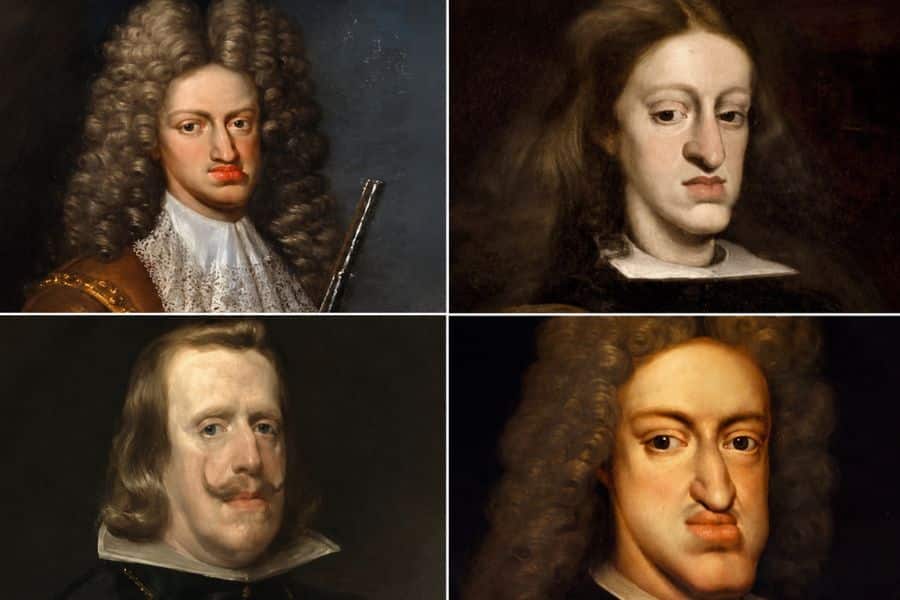
The family carried a very visible marker of their intermarrying, so famous it has its own name, the Habsburg jaw. Sufferers had a heavy, jutting lower jaw, often paired with a droopy, bulbous lower lip, a condition doctors call mandibular prognathism.
For a long time this was just an observation, but in 2019 a study led by Roman Vilas put it on a firm footing. His team gathered 66 portraits of 15 Habsburgs and had facial surgeons rate each royal face for the tell-tale features, then compared the severity against each person’s degree of inbreeding. They found a clear link.
The more inbred the Habsburg, the more pronounced the jaw. The worst case of the jutting jaw belonged to Philip IV, while the pinched, underdeveloped upper face was most severe in Charles II. It was the first proper scientific proof that this royal “look” was the direct result of the family marrying itself, generation after generation, written right into their faces.
The Children Who Simply Didn’t Survive
Among the Spanish Habsburg children, only about half lived to see their first birthday. In the ordinary Spanish villages of the same period, by contrast, around eighty percent of babies survived infancy.
A peasant child stood a far better chance of living than a prince born into all that wealth and privilege, purely because the prince’s parents were so closely related. The researchers reckoned that inbreeding at the level of first cousins alone cut a child’s odds of reaching the age of ten by nearly eighteen percent.
So the very strategy meant to secure the succession was steadily killing off the heirs it produced, one small coffin at a time.
Charles II, the Bewitched: A Dynasty’s Dead End
All of it, the centuries of cousins and nieces, the collapsing family tree, the doomed babies, came to rest in one tragic man. Charles II of Spain, born in 1661, was the final, ruined product of the whole experiment, and his own parents were an uncle and niece.
His story is truly heartbreaking. He was so disabled that he did not learn to speak until he was nearly four or walk until he was eight. His Habsburg jaw was so extreme that his upper and lower teeth could not meet, so he could barely chew and drooled constantly, and one horrified foreign envoy wrote that he swallowed his food whole.
He suffered fits, an oversized tongue, and a string of other ailments, and his court, unable to explain it, decided he must be the victim of witchcraft, which earned him his sad nickname, El Hechizado, the Bewitched.
Researchers today think his tangle of symptoms fits two separate rare inherited disorders landing in one unlucky body, exactly the sort of double blow that extreme inbreeding makes far more likely.
He married twice and fathered no children at all. When he died in 1700, aged just thirty-eight, the Spanish Habsburg line that had once ruled half the world died in the bed with him.
The Empire That Ate Itself
Charles II’s childless death was a continental disaster. With no Habsburg heir to inherit the Spanish crown and its enormous empire, the great powers of Europe went to war over the spoils in the War of the Spanish Succession, a bloodbath that dragged on from 1701 to 1714 and reshaped the map of the world.
A monarch too frail to produce a son had, in the end, plunged Europe into more than a decade of fighting. And there’s the bitter irony at the heart of the whole story. The Habsburgs rose to greatness by marrying cleverly, gathering an empire through the wedding contract while their rivals bled on battlefields.
Then they threw it all away by marrying too cleverly, folding the family in on itself again and again until there was nothing left to inherit the prize but a sickly, childless king. The very tool that built the empire was the tool that destroyed the family. They were undone not by an enemy, but by themselves.
FAQS
Why did the Habsburgs inbreed?
The Habsburgs deliberately inbred to keep their vast inherited lands and titles within the family rather than lose them to outside dynasties through marriage. Having built their empire through clever weddings, they then married cousins, and even uncles to nieces, to stop that empire being diluted. The Church required a papal dispensation for such close matches, which the wealthy family readily obtained.
What was the Habsburg jaw?
The Habsburg jaw was a distinctive facial deformity common in the dynasty, featuring a heavy, jutting lower jaw and often a droopy lower lip, known medically as mandibular prognathism. A 2019 study of 66 royal portraits found a clear link between the severity of the jaw and the degree of inbreeding, confirming it was the result of generations of the family marrying close relatives.
How inbred was Charles II of Spain?
Charles II of Spain was extraordinarily inbred, with an inbreeding coefficient of about 0.254. That is roughly the same value expected for a child born to full siblings or to a parent and child, even though Charles had two separate parents. Two centuries of Habsburg cousin and uncle-niece marriages had concentrated his ancestry to this extreme degree.
Did inbreeding end the Habsburg dynasty?
Yes, inbreeding is considered a major reason the Spanish Habsburg dynasty ended. Generations of marrying close relatives left the final king, Charles II, disabled and infertile, and Habsburg child mortality was severe, with only about half of children surviving to age one. When Charles II died childless in 1700, the Spanish Habsburg line died with him.
What happened after Charles II of Spain died?
After Charles II died childless in 1700, the great powers of Europe went to war over who would inherit the Spanish empire, in the War of the Spanish Succession, which lasted from 1701 to 1714. A king too frail from inbreeding to produce an heir had, through his death, plunged Europe into more than a decade of fighting and reshaped the continent.

I’m Kylie Lang. A travel journalist specializing in France. I’ve been fascinated by the Middle Ages for as long as I can remember. Based in the rural French countryside, I spend my days visiting medieval castles, wandering through medieval villages, and researching the real stories behind history’s most infamous figures.
Related posts:
 Inside the Spanish Habsburg Legacy of Inbreeding and Their Eventual Collapse
 The Tragic Life of Charles II of Spain: Illness, Inbreeding, and the Fall of a Dynasty
 Empress Sisi’s Lost Jewels Found After 100 Years Hidden in Canadian Bank Vault
 Six Women Who Dodged a Bullet, or Axe, by Not Marrying Henry VIII