The Habsburgs liked to keep things in the family, literally. It is one of the most documented habits of a dynasty that ruled huge parts of Europe for centuries. They built an empire through marriages that looped back on themselves, and then continued looping until the family tree resembled a knot.
When you look at a map of their territory around the year 1700, you’ll see that one family controlled land from central Europe to Spain and across the seas. Power like that creates its own rules, and for the Habsburgs, the rule was simple. Marry inside the family and keep every scrap of land and title within reach.
Table of Contents
In Spain, they took this further than anyone else with the Spanish Habsburg legacy of inbreeding. Their story ended in 1700 when Charles II died without an heir. His death closed the final chapter of a line that had spent generations tying itself tighter and tighter through marriages between first cousins, second cousins, uncles, and nieces. It was a plan that worked for a long time, until it didn’t.
The Habsburg Web of Power
The Habsburgs expanded their influence through strategic marriages, loyal alliances, and a steady hold on territory that spanned nearly half of Europe. By the time the early modern period arrived, the family had divided into two main branches. One held power in central Europe. The other shaped the fortunes of Spain and its empire.
This was a family that understood the value of geography. A marriage was a deal that shifted borders and secured crowns. Every generation added another layer to a political network that reached from the Alps to the Atlantic.
The web tightens when you look at who married whom. The idea was to protect everything they had built. Keeping land inside the family meant choosing spouses from within the same bloodline. It was seen as smart statecraft. For centuries, it appeared to work. Every decision, every match, and every ceremony fed a dynasty that looked almost untouchable.
The Spanish branch stood out for how often these connections repeated. Their story illustrates how a clever strategy can become a problem when the same names appear on both sides of the marriage contract for generations.

Why The Habsburgs Married Each Other
For the Habsburgs, marriage acted as a political tool. Land, influence, and royal titles were often transferred through marriage contracts, making it practical to choose a spouse from within the family. It kept everything in familiar hands and reduced the chance of rivals stepping in.
Europe was full of ambitious families, and every major house looked for ways to protect its borders. The Habsburgs simply doubled down on a method that seemed to deliver results. A cousin could be trusted. A niece already belonged to the dynasty. An uncle controlled territory that fit neatly into the wider plan. In a world built on power and survival, these choices made sense on paper.
The problem appeared slowly. Generation after generation drew from the same pool of relatives. The Spanish line became the most extreme example of this pattern. What began as strategic thinking turned into a cycle that tightened with each marriage contract. The result shaped the future of an entire kingdom and eventually brought the line to its end.

The Spanish Habsburg Legacy of Inbreeding
The Spanish Habsburgs took the family strategy of marrying inside the bloodline to a level that still surprises historians. Between 1516 and 1700, more than eighty percent of their marriages involved close relatives. This was not an accident but a deliberate attempt to keep an enormous global empire under tight control.
Spain sat at the height of its power during the early generations of this branch. Its rulers governed territories in Europe, the Americas, and parts of Asia. With so much at stake, the family believed that bringing in outsiders carried too much risk. Marrying a cousin or an uncle kept the map stable. At least, that was the thinking.
Over time, the pattern intensified. The same families appeared again and again in the marriage records. The same bloodlines repeated with little variation. It created a chain that kept power concentrated in one place, but it also passed the same genetic traits from parent to child with increasing force. By the seventeenth century, the Spanish branch was dealing with the consequences of choices made a century earlier.

The Habsburg Chin
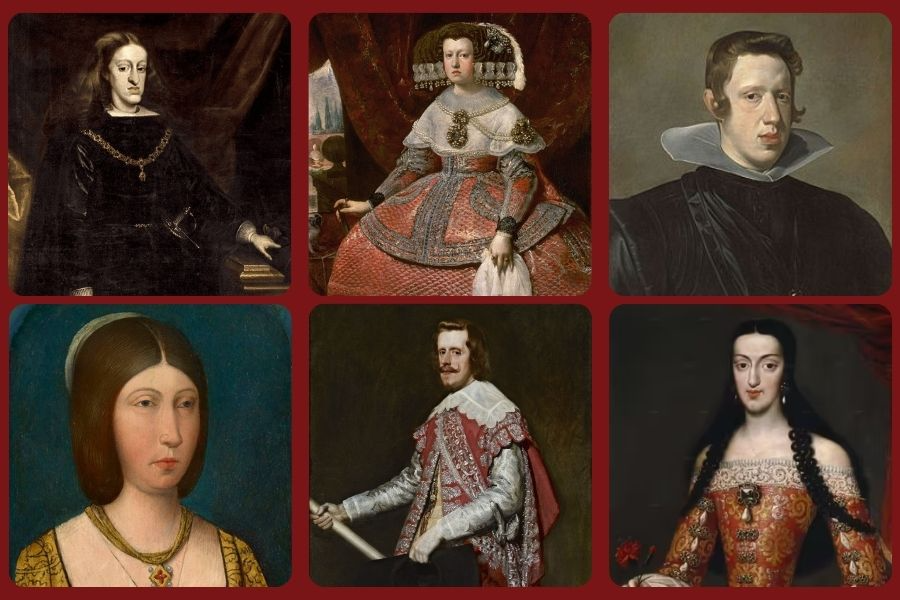
The most recognizable physical feature of the dynasty showed up in portraits long before anyone understood genetics. The Habsburg chin was a pronounced jaw that became stronger with each generation, especially in the Spanish line. It was not a simple quirk of appearance. It shaped how some members of the family spoke, ate, and carried themselves at court.
Several rulers showed the trait clearly. Charles II had the most extreme form of it. His lower jaw jutted so far forward that chewing and swallowing caused real difficulty, and contemporary observers wrote about how exhausting meals could be for him.
Philip IV also exhibited a strong version of this trait, which is evident in nearly all of his portraits. Earlier in the line, Charles I of Spain, known elsewhere as Charles V, displayed a less severe but still visible version.
Women in the dynasty were not spared. Mariana of Austria, who served as regent and was the mother of Charles II, appears in Velázquez’s portraits with the same distinctive jaw shape. Catherine Renata of Austria, a lesser-known member of the wider family, also showed clear signs of the trait. These examples demonstrate that the feature was passed through both male and female lines and became more pronounced as intermarriage continued.
The chin became a physical record of the choices the dynasty made. It appeared generation after generation, each time slightly more defined, until it became one of the most famous examples of how close kin marriages can shape a ruling house. Citations at the end.

Charles II Of Spain
Charles II entered the world carrying the weight of generations of close intermarriage. His parents were uncle and niece, and the family line behind them repeated the same pattern many times. The result was a ruler whose health never matched the demands of the Spanish crown. Contemporary accounts describe a man who struggled with physical weakness and frequent illness, along with developmental difficulties that shaped his entire life.
He inherited the throne as a child and spent his years surrounded by advisers who managed the kingdom while he fought constant medical problems. Spain needed a strong ruler during a period of political tension, but Charles spent much of his life trying to cope with conditions over which he had no control. His body became a symbol of what repeated inbreeding could produce in a royal line.
The greatest issue for the dynasty came from his inability to produce an heir. Marriage did not solve the problem, and every year without a child pushed Spain closer to a crisis. When Charles died in 1700, the Spanish branch of the Habsburg dynasty came to an end with him. His death opened the door to a major succession struggle and reshaped the balance of power in Europe.

How Inbreeding Affected Politics And Power
The Habsburg strategy of keeping marriages inside the family worked only as long as their rulers stayed strong enough to manage the pressure of a vast empire. By the seventeenth century, the Spanish branch faced a very different reality. Years of repeated intermarriage produced heirs who struggled with health problems, weakening the stability of the crown.
Spain needed consistent leadership to handle wars, finances, and the daily demands of the empire. Instead, it often relied on advisers who acted in the ruler’s place. This created power struggles inside the court. Rival groups vied for influence, and decisions that shaped the kingdom’s future were made by individuals seeking control rather than long-term stability.
The real turning point came with Charles II. His health issues made it difficult for him to govern, which left Spain vulnerable during a time when other European powers were growing stronger. Without an heir, the situation was on the verge of crisis. His death invited competing claims to the throne. Those claims helped ignite the War of the Spanish Succession, a conflict that pulled Europe into one of the largest power struggles of the era.
In the end, the political system that the Habsburgs had carefully built began to collapse under its own weight. The same marriages that once strengthened the dynasty eventually helped bring down one of its most influential branches.

I’m Kylie Lang. A travel journalist specializing in France. I’ve been fascinated by the Middle Ages for as long as I can remember. Based in the rural French countryside, I spend my days visiting medieval castles, wandering through medieval villages, and researching the real stories behind history’s most infamous figures.
Related posts:
 The Tragic Life of Charles II of Spain: Illness, Inbreeding, and the Fall of a Dynasty
 Six Women Who Dodged a Bullet, or Axe, by Not Marrying Henry VIII
 The Ones That Got Away. The Six Women Who Kept Their Heads, By Not Marrying Henry VIII
 The Best and Worst Kings of the Middle Ages That the History Books Rarely Talk About