Ivar the Boneless was a 9th-century Viking leader and the son of Ragnar Lothbrok, who commanded the Great Heathen Army that invaded England in 865.
His nickname likely points to a real physical condition, possibly a bone disorder such as osteogenesis imperfecta that weakened his legs, though the sagas also claim impotence or a curse.
Table of Contents
Nobody knows for certain. What we do know is a great story. So grab a cuppa and settle in for an interesting tale.
Who Was Ivar the Boneless, Really?
Ivar was a real Viking warlord of the 9th century. By saga tradition, he was a son of Ragnar Lothbrok and Aslaug, one of the shield maidens of legend, and in 865 he led the Great Heathen Army into England.
Most of what we think we know about Ivar comes from Norse sagas written centuries after his death, closer to the 1200s than to his own lifetime.
So when you read the famous tale of him avenging his father in a pit of snakes, treat it the way you’d treat a family story told and retold at Christmas for four hundred years. There’s a grain of truth in there somewhere. Good luck finding the edges of it.
There’s an Irish thread too. Many historians identify Ivar with a warlord called Ímar, who founded the Uí Ímair dynasty, which went on to shape Ireland, Scotland, and the Isles for generations.
If they’re right, and plenty think they are, then Ivar wasn’t just a raider who passed through, but the root of a royal house.
Which leaves us with the two questions everyone actually wants answered. What on earth was wrong with him? And was he really as brutal as the TV Shows make out?
What Was Wrong With Ivar the Boneless?
The most popular medical theory is osteogenesis imperfecta, better known as brittle bone disease. It’s a genetic condition that affects how Type 1 collagen is made, and since collagen is one of the building blocks of bone, the bones become fragile and prone to breaking, sometimes from nothing more than a minor knock or a fall.
Picture what that would mean day-to-day in the 9th century. Legs that fractured easily, no plaster casts, no surgeons, no wheelchairs. A man who might well need to be carried, which lines up rather neatly with the saga descriptions of Ivar being borne into battle on a shield.
Some people with the condition can walk with support. Others never do. It also tends to be associated with short stature and bone deformities as they grow.
It’s not the only diagnosis on the table. Others have floated neuromuscular conditions that weaken the muscles, juvenile arthritis, and Ehlers-Danlos syndrome, which affects the connective tissue and can leave joints alarmingly loose.
Any of them could fit a man remembered as unable to use his legs.
None of it can be confirmed, though. No one has ever dug up a body we can be sure is Ivar’s and put it under a modern medical eye. Every diagnosis is educated guesswork.
Why Was He Called “the Boneless”?
In Old Norse, he’s Ívarr hinn beinlausi, Ivar the Boneless, and the maddening truth is that nobody agrees on what the name was meant to signify. It has puzzled historians for centuries.
There are three main thoughts on it. The first is the literal one: a real condition that left his legs weak or useless, so weak that one saga says he had gristle where his bones should have been.
The second is impotence, since Ivar is said to have died without children, and “boneless” may have been a rather unkind medieval euphemism.
The third is that it’s a muddle in translation, a Latin epithet meaning something like “the Hated” that got garbled into “without bone.”
Then there’s the saga’s own explanation, which is pure storytelling. Ivar’s mother Aslaug, who could see what was coming, warned Ragnar to wait three nights before consummating their marriage. Ragnar, being Ragnar, didn’t wait. And so the boy was born boneless, the price of a husband’s impatience.
I’ll offer you one more, because it’s my favorite. A few people think “boneless” was never an insult at all, but a nod to how supple and quick he was, a snake of a man. It would sit well in a family where another brother went by Sigurd Snake-in-the-Eye.
Hooked on the Middle Ages? Get more stories like this one in your inbox.
Was Ivar the Boneless Actually Disabled, or Was That an Invention for TV Drama?
Ivar’s disability isn’t a modern flourish dreamed up for television. It’s right there in the medieval sources. The screen version leaned into it hard and gave us the crawling and the crutches, but the bones of the idea, if you’ll forgive the pun, are old.
The Norse accounts describe him being carried into battle, sometimes on a shield, sometimes wielding a bow, while others bore him along. Now, there is a fair counter-argument here.
Chieftains were sometimes lifted onto shields as a mark of honor, hoisted up after a victory, the way we’d chair a winning captain off a pitch. So a man on a shield isn’t automatically proof of weak legs.
But it does raise the obvious question. How does a man who can’t stand lead an army of thousands? The answer tells you everything about how Viking leadership actually worked. It ran on reputation, on bloodline, and above all on cunning. Ivar was remembered as the cleverest of Ragnar’s sons, the strategist, the one who won by outthinking the other fellow rather than out-muscling him. He had brothers and warriors to carry out the plan. What he needed was the plan.
Picture him directing a battle from a litter or a cart, reading the ground, moving men like pieces on a board while he stayed still. Not despite the disability, but around it.
The Great Heathen Army and Ivar’s Invasion of England
In 865, something changed on the English coast, and it wasn’t another summer raid. Ivar and his brothers landed with what the Anglo-Saxons called the Great Heathen Army, and this lot hadn’t come for silver and a quick sail home. They’d come to stay.
They landed in East Anglia, met little resistance, and struck a deal for horses. Then they turned north into Northumbria and took the city of York in 866. In a second battle the following March, in 867, they killed both King Ælla and the deposed King Osberht.
If you know the legend, this is the famous moment: Ælla, the man blamed for throwing Ragnar into that snake pit, was put to death by the sons in revenge, supposedly by the horrific “blood eagle.” Whether the blood eagle was ever real or just a poet’s nightmare is still argued over. Either way, Ælla’s reign ended at the hands of a Viking sword.
Instead of sailing off, the army installed a puppet ruler named Egbert to hold Northumbria for them, and pushed on. This was conquest, not raiding, and it’s the same Great Heathen Army that a young Alfred the Great would spend the rest of his life fighting to push back.
Ivar wouldn’t be the last Viking warlord to bring England to its knees, either, but he was among the first to show it could be done and held.
The cruelest chapter came in 869, when the army returned to East Anglia and its king, Edmund, refused to give up his Christian faith. They killed him for it. The Church remembered him as Edmund the Martyr, and his death did more for his fame than his reign ever had.
How Did Ivar the Boneless Die and Where Is He Buried?
The sources put Ivar’s death somewhere between 870 and 873, and for once, they broadly agree on the manner of it: sudden and horrible. He was struck down fast by a savage illness.
Some historians wonder whether a late-life disease that wasted him away is the real origin of the “boneless” name, a body failing at the end rather than a condition he was born with. We’ll never know for sure.
Where he lies is its own mystery. One candidate is Repton in Derbyshire, where the Great Heathen Army spent the winter of 873 and where archaeologists uncovered something extraordinary. A mass grave holding the jumbled remains of at least 264 people, tucked under a low mound near St Wystan’s church.
Radiocarbon dating has tied those bones to a single event in the late 9th century, matching the winter the army camped there. Around 80 percent were men, mostly aged 18 to 45 and carrying the marks of violent injury, and five silver pennies dated to between 872 and 875 were found among them.
Local legend even spoke of a giant warrior buried nearby. It’s a wonderful thought that Ivar might be in there. It has never been proven.
The other candidate is Dublin. If Ivar really was the Ímar who died in 873 as “king of the Norsemen of all Ireland and Britain,” then his grave lies across the Irish Sea, not under an English churchyard.
Take your pick. The real answer is that we don’t know.
Ivar the Boneless in Vikings vs the Real History
So how does the show hold up? Better than you might fear, and worse than a purist would like.
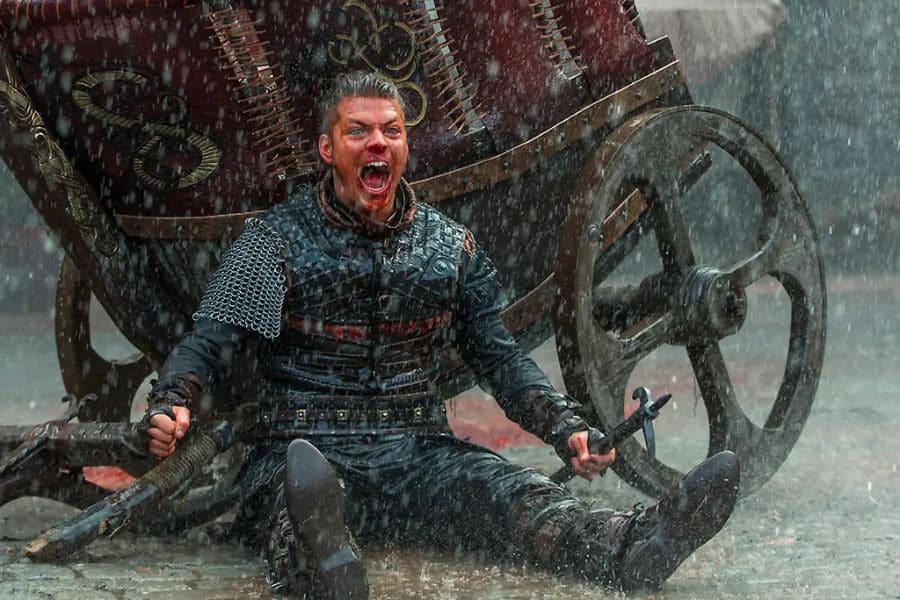
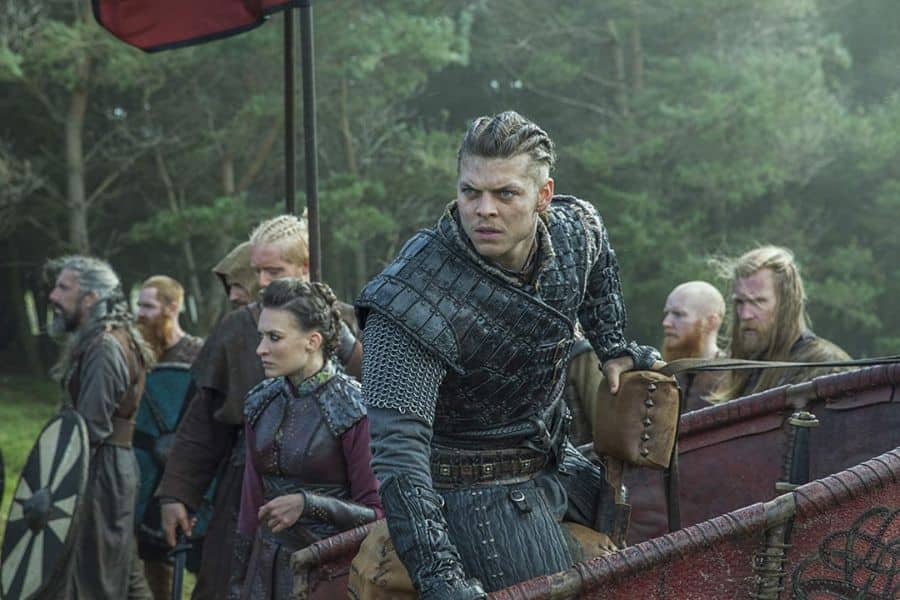
What History’s Vikings gets right is the shape of the man. The strategic brilliance is there, as is the disability, portrayed as osteogenesis imperfecta, which is the leading real-world theory rather than a writer’s invention.
The Great Heathen Army is real, the brothers are real, and the revenge against Ælla for their father’s death is drawn straight from the sagas. Even Ivar’s brothers Ubbe and Hvitserk have roots in the historical record.
Where it drifts is the personal drama. The betrayals, the exact rivalries, the intimate scenes between brothers and lovers, most of that is television doing what television does best, filling the enormous silences the sources leave behind.
If you like your Vikings with a good story attached, you’ll fall for Lagertha, Ragnar’s legendary shield maiden of a wife, and Rollo of Normandy, the raider who went on to found a dynasty in France. And if it’s the drama you’re after more than the footnotes, there are plenty of other medieval dramas worth an evening.
Frequently Asked Questions
What Was Wrong With Ivar the Boneless?
Nobody is entirely sure what was wrong with Ivar the Boneless, but the leading theory is that Ivar had osteogenesis imperfecta, brittle bone disease, a genetic condition that makes bones fragile and easily broken.
Why Was Ivar Called “the Boneless”?
Nobody knows why Ivar was called “the Boneless”, which is half the fun. The most popular reading is a real condition that left his legs weak, so weak the sagas said he had cartilage where bone should be. Others argue it meant impotence, since he reportedly died childless. There’s even a theory that it’s a Latin mistranslation. The nickname has puzzled historians for centuries.
Was Ivar the Boneless a Real Person?
Yes. Ivar the Boneless was a real 9th-century Viking leader who commanded the Great Heathen Army that invaded England in 865. The trouble is that most of what we know comes from sagas written down centuries later, so his family ties to Ragnar Lothbrok and the dramatic revenge story sit somewhere between history and legend.
How Did Ivar the Boneless Die?
Ivar the Boneless died of disease. Sources place his death somewhere between 870 and 873. Some historians think this late illness could even be the real origin of his “boneless” nickname. Where exactly he died is disputed, with candidates in both England and Dublin.
Where Is Ivar the Boneless Buried?
We don’t know for certain where Ivar the Boneless is buried. One popular candidate is a Scandinavian burial mound at Repton in Derbyshire, where the Great Heathen Army wintered and where archaeologists found a mass grave of at least 264 people. Some suggest Ivar could be buried there. Others believe he died in Dublin, so the real answer is that his grave is still a mystery.
Love a good medieval story?
Join our readers and get tales of kings, queens, castles and ordinary medieval lives straight to your inbox.

Kylie Lang is a nationally syndicated travel journalist with bylines on the Associated Press Wire & more, a medieval history writer, and the founder and lead author of Tales of the Middle Ages (talesofthemiddleages.com). She holds a BA (Honours) in History from the University of Kent and is a member of the British Guild of Travel Writers.
Related posts:
 9 Legendary Female Viking Warriors Who Shaped History
 Did the Vikings Really Sail to America Before Columbus? Unraveling the Mystery of Vinland
 Fact or Fiction: Was Lagertha a Viking Hero or a Medieval Myth?
 What Drove the Vikings? How They Mastered the Art of Fear and Weaponized It. A Strategy That Shook Europe