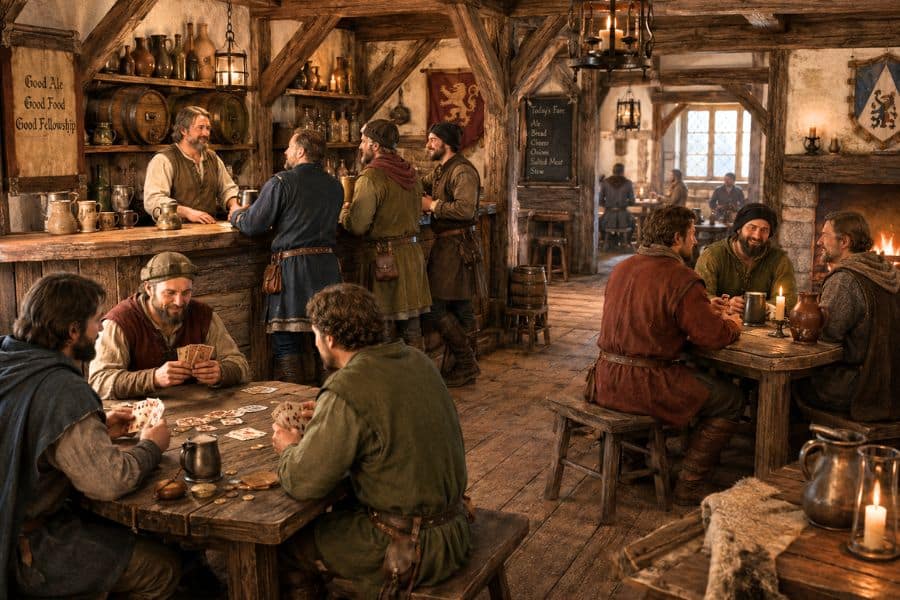
Walk into any medieval tavern, and you’d find the air thick with woodsmoke, sour ale, and the slap of dice on a battered table. Men shouted, coins changed hands, knives appeared faster than apologies. It was loud, dirty, and lit by tallow candles that smelled like a butcher’s apron.
It was also, oddly enough, one of the great factories of the English language. Half the phrases you still use without thinking were forged at those tables, between rounds of hazard and tankards of small beer.
Table of Contents
The drinkers and gamblers of the 13th to 17th centuries gave us a vocabulary of cheating, drinking, fighting, and skipping out on the check, and we kept it all.
1. Upper Hand
Picture two men in a smoky tavern arguing over who gets the first swing in a fight, or, more often, who gets first pick in a game. To settle it, one grabs the bottom of a wooden staff or a sword hilt. The other clamps his fist directly above. They keep stacking hands up the shaft, fist on fist, until someone runs out of wood at the top. That last hand, the one with nothing above it, won.
This was a real method of choosing sides, used for everything from street games to picking the order in a round of skittles. By the 1400s, the phrase was already drifting into figurative use, meaning the person in control of a situation.
2. Pass the Buck
This one has a longer journey than most. The buck in question was probably a buckhorn-handled knife, used in 19th-century American poker games to mark which player was due to deal next. When you didn’t want to deal, you passed the buck to the next man. Harry Truman put the famous sign on his desk in the 1940s.
But the gesture is older than the knife. Medieval and early modern gambling games used all sorts of tokens to mark the dealer or the next bettor, a coin, a stone, a piece of bone, or even a candle stub. The principle was the same: whoever held the marker took the responsibility, and shoving it sideways onto someone else was a recognized move at the table.
3. On the House
Alehouses in medieval and Tudor England ran on tight margins. Beer was the daily drink of every adult and most children, partly because the water in towns would kill you, and innkeepers competed hard for regulars.
One of the oldest customer loyalty schemes in the language was the free drink: order a few, and the next was on the house. The phrase itself shows up in print in the 19th century, but the practice runs straight back through the alehouse tradition.
Tavern keepers also used free drinks to soften up arguments, settle small disputes, or shut up a customer who was about to start swinging a stool. A round on the house was cheaper than a broken bench.
Hooked on the Middle Ages? Get more stories like this one in your inbox.
4. Wet Your Whistle
I remember my Dad used to say a lot, and there’s a folk story floating around that medieval tankards had whistles built into the handles, so you could blow for a refill. It’s nonsense. No surviving tankard has anything of the kind.
The real origin is older and simpler. Whistle was English slang for the mouth or throat from at least the 1300s. Chaucer uses it in The Reeve’s Tale, where a miller’s wife is described as having a wet whistle after a night of drinking. To wet your whistle was to have a drink, full stop. The mouth was the whistle, and the ale was the wetting.
Having studied Chaucer at school, I like that he’s the earliest writer we can pin this to, because it places the phrase right in the world of the Canterbury Tales, drunken millers, dodgy innkeepers, and pilgrims who claim to be holy and are anything but.
5. Mind Your Ps and Qs
Several origin stories compete for this one, and historians disagree, so I’ll give you the leading tavern theory and flag the others. In English alehouses, drinks were often served in pints and quarts, and tabs were chalked up on a board behind the bar. P stood for pint, Q for quart. A customer who wanted to keep his bill honest, or an innkeeper who wanted to keep his accounting straight, had to mind his Ps and Qs.
The phrase is attested from the late 1600s, which fits the chalked-tab era. Printers also had a version, since lowercase p and q are mirror images and easy to confuse when setting type backward.
Both trades probably contributed. The drinkers got there first in everyday speech.
When a parent tells a child to mind their Ps and Qs at the dinner table, they’re passing on a barkeep’s warning. Drink steadily, count carefully, and don’t argue with the slate.
6. Throw in the Towel
Medieval and early modern prize fights, often held in tavern yards, used a piece of cloth, a sponge, or a rag thrown into the ring to signal surrender. The fighter’s second made the call when his man was too bloodied to continue. Sometimes the fighter made it himself when he could still see.
Tavern yards were the natural venue. They had a flat space, walls to keep the crowd in, an audience already drunk enough to bet, and a landlord ready to take a cut. Fights were brutal, bare-knuckle, and often fatal, but the cloth was a call for mercy.
The phrase survived the move into formal boxing because the action was so recognizable. A rag arcs over the crowd, lands in the dirt, and the fight is done. Anyone who’d ever stood in an inn yard with a tankard and a wager knew what it meant.
7. Cold Shoulder
The image most people carry is a Victorian one, a frosty lady turning her shoulder away from a suitor she’s done with. The actual root is older and much more practical. In medieval and Tudor England, a welcome guest at an inn or great house was served a hot meal, often roast meat fresh from the kitchen.
A guest who’d outstayed his welcome, or who was passing through without much standing, got the cold shoulder of mutton from yesterday’s joint.
It wasn’t an insult exactly. Cold meat was food, and a hungry traveler took what was offered. But the message was clear. You’re not getting the good treatment, and you shouldn’t expect a bed for two nights. The innkeeper’s wife had already moved on to the next problem.
Walter Scott popularized the phrase in print in the 1810s, which is why people associate it with drawing rooms, but he was reaching back into older tavern and household practice.
Love a good medieval story?
Join our readers and get tales of kings, queens, castles and ordinary medieval lives straight to your inbox.

Kylie Lang is a nationally syndicated travel journalist with bylines on the Associated Press Wire & more, a medieval history writer, and the founder and lead author of Tales of the Middle Ages (talesofthemiddleages.com). She holds a BA (Honours) in History from the University of Kent and is a member of the British Guild of Travel Writers.
Related posts:
 10 Ancient Phrases We Still Use Today, From the Grossest in the English Language to Those Born From Medieval Scams
 The Forgotten East Yorkshire Plot to Kill Henry VIII: Magic, Treason, and the Black Fast
 The Surprising (and Sometimes Gross) Origins of Medieval Sayings
 The Curious Stories Hidden in the Old Pub Signs in England