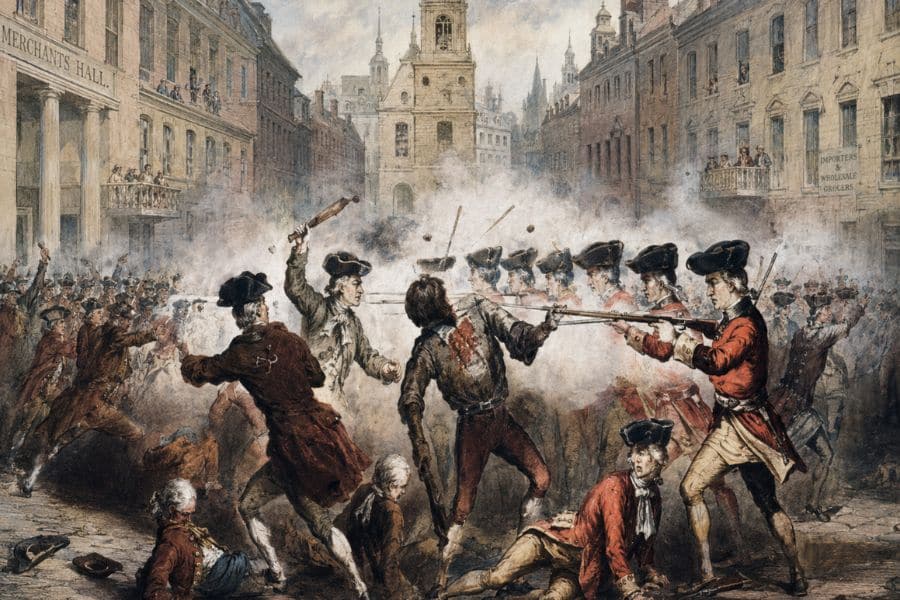
On the night of March 5, 1770, a small squad of British soldiers fired into a crowd outside the Custom House on King Street in Boston. Five colonists ended up dead. Within hours, Paul Revere was already engraving the scene as a coordinated slaughter, and within weeks, the city was demanding the soldiers hang.
The man who stood up in court to defend those eight British soldiers, and their captain, was John Adams. He wasn’t a Loyalist or a hired gun. The same John Adams who would, six years later, push hardest for a clean break with the Crown.
Table of Contents
The trial that followed is one of the strangest set pieces in American legal history. The version most of us got in school skips the witness testimony, the lawyering, and the awkward thing Adams wrote in his diary about it afterward.
What Actually Happened on King Street
Boston in 1770 was a city under occupation. Roughly 2,000 British regulars had been quartered there since 1768, sent to enforce customs laws that the locals were doing everything possible to dodge.
Soldiers moonlighted as dockworkers, undercutting wages, and officers were jeered in the streets. It was the kind of slow-burning hostility that doesn’t need much to catch alight.
On the evening of March 5, a young wigmaker’s apprentice named Edward Garrick started shouting at a British officer over an unpaid bill. A sentry on duty outside the Custom House, Private Hugh White, told the boy to shove off.
Garrick mouthed back, and White cracked him on the head with the butt of his musket. Word spread fast, and within an hour, a crowd had gathered, throwing snowballs, oyster shells, chunks of ice, and whatever else came to hand. Church bells rang, which in Boston usually meant fire, so more people poured into the streets.
Captain Thomas Preston marched a relief party of seven soldiers down to rescue White. They formed a half-circle in front of the Custom House, muskets loaded, bayonets fixed. The crowd swelled to several hundred, and the people dared the soldiers to shoot.
Someone threw a club, and a soldier, Private Hugh Montgomery, was knocked down, got back up, and fired. Then more shots, ragged, not a volley. When the smoke cleared, three men lay dead. Two more would die of their wounds later. Among the dead was Crispus Attucks, a sailor of African and Wampanoag descent, who was at the front of the crowd.
Why the Soldiers Couldn’t Find a Lawyer
By morning, Boston wanted blood. Samuel Adams and the Sons of Liberty went to work immediately, framing the killings as a deliberate massacre by a tyrannical standing army. Revere’s engraving, which he based on a drawing by Henry Pelham and rushed to print, showed the soldiers firing in neat lines on Preston’s order into a crowd of unarmed, well-dressed townspeople.
It was propaganda, and it was effective. Copies went up everywhere.
Preston and the eight soldiers were arrested and charged with murder, and of course, they needed lawyers. But no Boston attorney with any sense of self-preservation wanted to touch the case. Defending the regulars meant career suicide at best and a brick through the window and a possible beating or attack at worst. Preston, writing from his cell, sent word that he needed counsel.
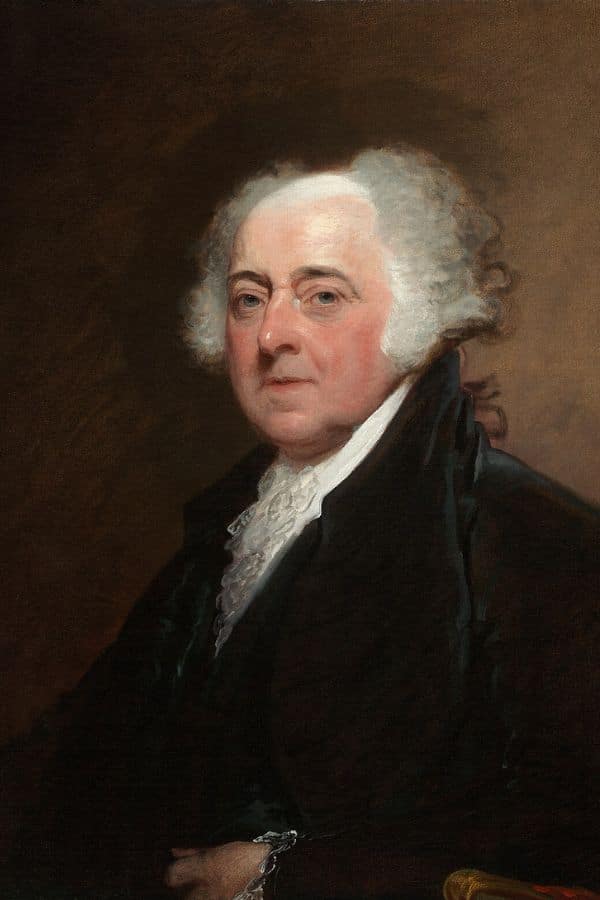
The request reached John Adams through a Loyalist merchant named James Forrest, who showed up at Adams’s office in tears. Adams was 34, a rising lawyer with a young family and a growing political reputation as a critic of Parliament. He took the case the same day.
His fee was a token amount, around 18 guineas in total across both trials, which barely covered his time. He later wrote that he expected to lose half his practice and possibly worse, and he did it anyway.
The reason he gave, then and afterward, was that no man in a free country should be denied counsel and a fair trial, and that to let the soldiers be lynched by a mob in a courtroom would be a worse stain on Boston than the killings themselves.
John Adams, the HBO Mini Series
If you haven’t seen it yet, this min series about the life of John Adams gives a fascinating look at the man and the Boston Massacre.
Hooked on the Middle Ages? Get more stories like this one in your inbox.
The Two Trials and the Mess of the Evidence
The Crown’s prosecutors, Robert Treat Paine and Samuel Quincy, agreed to try Preston separately from his men. This was a gift to the defense. Preston’s trial, which began in late October 1770, turned on a single question: had he given the order to fire? If yes, he was guilty of murder. If no, the soldiers might still hang individually, but he walked.
The witnesses, dozens of them, contradicted each other completely. Some swore they had heard Preston shout “Fire!” Others swore the opposite, that he had shouted “Do not fire!” or “Hold your fire!” Several said he’d been standing in front of his men, which is exactly where an officer who actually wanted them to fire would never stand.
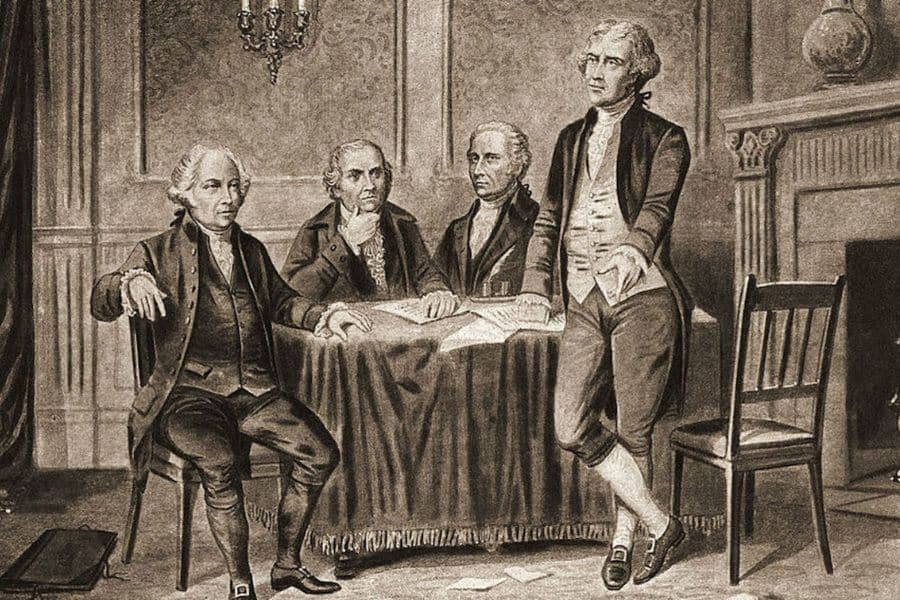
Adams and his co-counsel Josiah Quincy Jr., Samuel’s younger brother, leaned hard on the confusion. If the jury couldn’t be sure he gave the order, they had to acquit. They did. Preston walked out a free man at the end of October.
The soldiers’ trial in late November was harder. Someone had clearly fired, and one of them was Montgomery, the one knocked down. Adams’s argument was that the soldiers had acted in self-defense, or at worst in the heat of legal provocation, and that the law of homicide in such circumstances didn’t call for hanging.
He walked the jury through what a Boston mob actually looked and sounded like that night. Witnesses described a crowd of several hundred armed with clubs and ice, pressing in close, daring the soldiers to shoot.
One witness, a man named Richard Palmes, had been standing right next to Preston with his own cudgel in hand. The defense produced surgeons who described the wounds. They produced character witnesses for the soldiers. They reminded the jury that the men were under standing orders not to fire without a magistrate’s say-so, and that no one had given that order.
The Speech, the Verdict, and the Branded Thumbs
Adams’s closing argument in the soldiers’ trial ran for hours across two days. The most-quoted line from it is the one that still gets stitched on tote bags in gift shops at the Old State House: “Facts are stubborn things; and whatever may be our wishes, our inclinations, or the dictates of our passion, they cannot alter the state of facts and evidence.”
He hammered on the law of self-defense and on the burden of proof. He told the jury plainly that if they convicted these men on the evidence before them, they would be doing the work of the mob, not the work of justice.
The jury came back after about two and a half hours. Six soldiers were acquitted outright. Two, Montgomery and a Private Matthew Kilroy, were convicted of manslaughter rather than murder. Under an old legal provision called benefit of clergy, they avoided the gallows. They were branded on the thumb with an M, for manslaughter, in open court, and released.
For the defense, this was an extraordinary result given the political temperature in Boston at that time.
The verdict held. There was grumbling, there were pamphlets, but there was no riot. Adams went back to his practice, which, against his expectations, didn’t collapse. His allies, including his cousin Samuel, made sure his political career survived. Within two years, he was back in the Massachusetts House, and within five, he was at the Continental Congress, drafting the case for independence.
What Adams Wrote About It Afterward
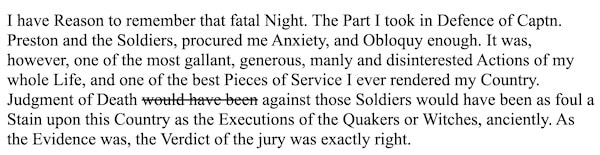
Three years after the trial, in 1773, Adams sat down with his diary and wrote one of the most striking passages he ever produced about his own career. He called his defense of the soldiers “one of the most gallant, generous, manly and disinterested Actions of my whole Life, and one of the best Pieces of Service I ever rendered my Country.”
He said the verdicts had been “exactly right.” He added that if the soldiers had been hanged on perjured testimony and mob pressure, the killings would have been as foul a stain on the country as anything in its history.
Here’s a man who, by 1773, was already deep in the resistance to Crown authority, who would within two years be arguing for an open break, and who looked back on his defense of British soldiers as the best thing he’d ever done in court.
But what happened to the two convicted soldiers? Montgomery, who fired first after being knocked down, reportedly admitted to a friend years later that he had shouted “Damn you, fire!” amid the chaos, and that his comrades had taken it as an order from Preston.
If true, and we only have it second-hand, it means the captain was acquitted in part because of the confusion the soldier himself had caused.
The historical record doesn’t give us an answer to who fired first or why. It gives us a frightened, outnumbered squad, a furious crowd, a thrown club, a man on the ground, and five bodies on the ice. Adams looked at that picture and decided the law had to hold anyway. Branded thumbs and all.

Love a good medieval story?
Join our readers and get tales of kings, queens, castles and ordinary medieval lives straight to your inbox.

Kylie Lang is a nationally syndicated travel journalist with bylines on the Associated Press Wire & more, a medieval history writer, and the founder and lead author of Tales of the Middle Ages (talesofthemiddleages.com). She holds a BA (Honours) in History from the University of Kent and is a member of the British Guild of Travel Writers.
Related posts:
 How One Colonial Judge Almost Stopped the Salem Witch Trials By Refusing To Continue and Riding Home Without Looking Back
 7 Historical TV Shows That Take You Back in Time (Perfect For Those Missing Outlander and the Scottish Highlands in the 8th Century)
 Must-Read Books on the Hundred Years War. These Page-Turners Nail It
 How Lady Worsley Turned Her Husband’s Humiliation into High Society Infamy