
The Gestapo kicked down her door on a sweltering July evening in 1944 in Aix-en-Provence. They were hunting for information about Alliance, the most effective resistance spy network in France. They were looking for its leader.
But their biggest mistake? Believing the person they were looking for was male. Some military mastermind who was coordinating 3,000 agents across every major French port and city.
Table of Contents
They never suspected the dowdy, bespectacled woman they pushed aside was the person they were actually searching for.
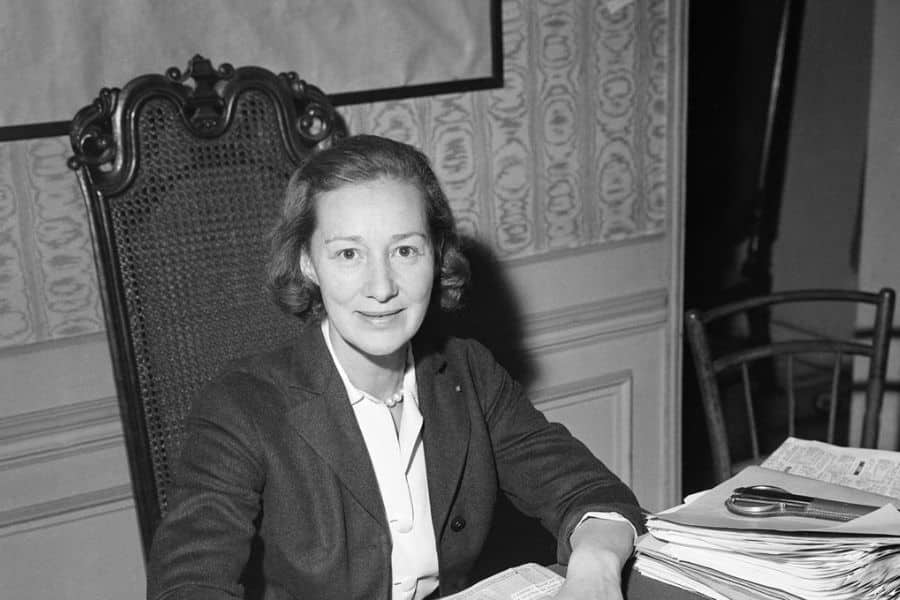
The Night the Gestapo Arrested Marie-Madeleine Fourcade
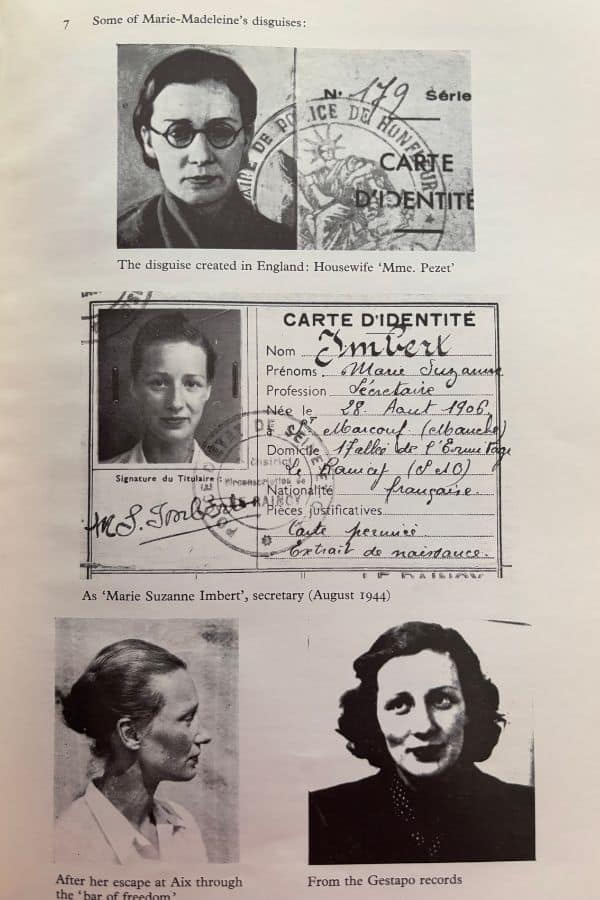
Marie-Madeleine Fourcade stood before the Gestapo with dyed black hair, thick glasses, and a dental prosthetic that altered the shape of her mouth. She’d been going by the name Germaine Pezet, playing the role of a boring Parisian housewife. The Gestapo officers tore her apartment apart looking for intelligence documents. And they found them: encoded reports, lists, and information they knew came from Alliance.
They just didn’t realize the spy they wanted was standing right in front of them.
They arrested her anyway and threw her in a military detention cell, telling her a senior Gestapo commander would interrogate her in the morning. And Marie-Madeleine knew exactly what that meant. She would be tortured, and eventually, they’d figure out who she really was.
She had a cyanide pill hidden in her handbag, as all members of the resistance had, but she didn’t take it, because she knew if she died, Alliance died with her. And Alliance had just helped make D-Day possible. The war was almost over, her agents were still out there, still gathering intelligence, still fighting, and they needed her.
She had two options: face the inevitable interrogation and torture or try to escape. It was the middle of the night, and the air in the barracks cell was suffocating. Hot and thick, typical July weather in southern France. Marie-Madeleine lay on the cot, drenched in sweat, fear mingling with the heat.
According to her forged papers, she was Germaine Pezet, just another French woman caught up in the resistance. But by morning, when the Gestapo commander arrived to question her, they’d figure it out. They always did. And then the torture would start.
She studied the cell window with its iron bars. There was a small gap, maybe too small. She was petite, yes, but was she really this small?
Marie-Madeleine took off her dress and all her other clothes. She didn’t want anything catching on the metal or adding any kind of bulk to her frame. Because fabric adds bulk. Fabric catches on metal. Clenching the dress between her teeth, she started squeezing.
The pain was excruciating. Her memoir later described it as “sheer agony.” The iron bars scraped her skin raw, and she thought she’d torn her ears off. Inch by agonizing inch, she forced her naked body through the impossibly small gap.
She jumped from the window ledge, landing hard and still naked except for the dress clenched in her teeth. She crawled across the street on her hands and knees through brambles and brush, then put on the dress and started running.
She made it to a cemetery and hid inside a crypt while sirens wailed through the town. Then she ran to a farmhouse outside Aix-en-Provence to warn her contacts that the Gestapo was coming for them too.
Her body was covered in abrasions and bruises, and her face and neck looked like someone had dragged her through barbed wire. But she was alive, and crucially, Alliance was still operational.
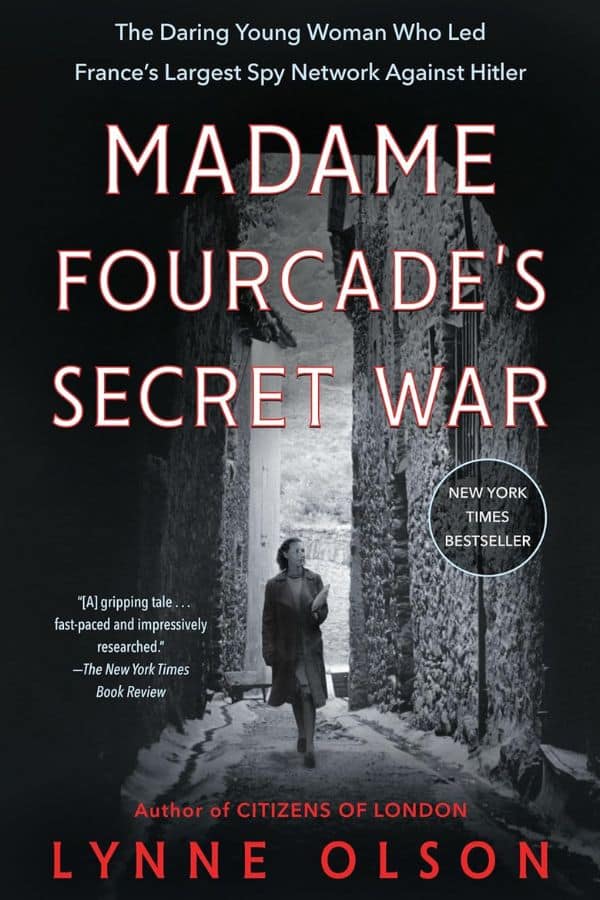
Madame Fourcade’s Secret War by Lynne Olson
Lynne Olson brings Marie-Madeleine’s world to life through a well-researched biography. It’s a gripping read that you can’t put down, and it helps you to realize just what people went through during WW2 and how lucky we are to live the life we have now.
The Socialite Who Became a Spymaster
Born Marie-Madeleine Bridou on November 8, 1909, in Marseille, she grew up in Shanghai, where her father worked for the French Maritime service. She attended convent schools and trained to be a concert pianist, dreaming of playing Chopin on concert stages across Europe. She was glamorous, cultured, and well-connected, the kind of woman who attended parties with diplomats and high-ranking military officers.
At seventeen, she fell in love with Édouard Méric, a French military intelligence officer. They married young and had two children together. For a while, they lived in Morocco, where she learned Arabic, helped deliver babies at a local women’s clinic, and picked up bits of intelligence work when her husband met with tribal leaders.
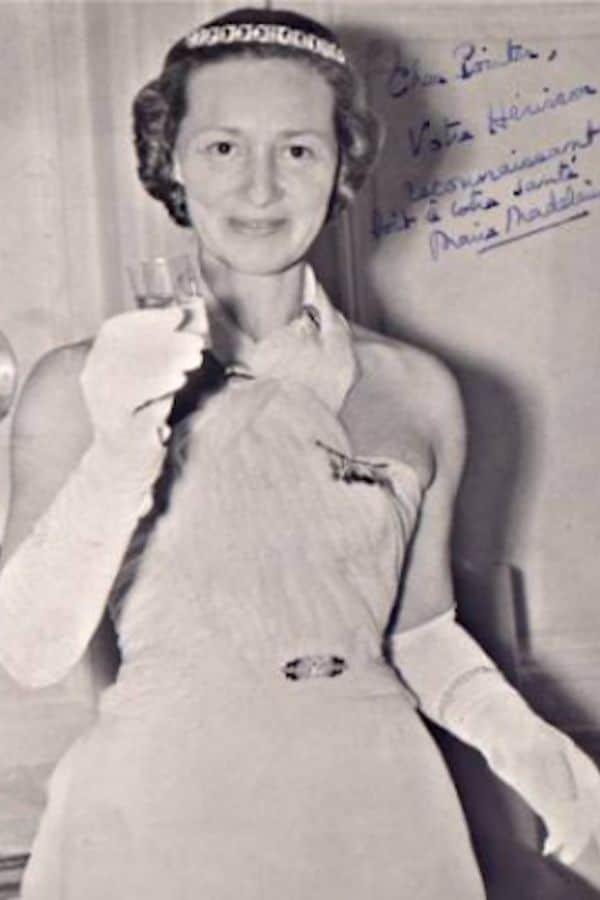
But the marriage sadly fell apart, and she returned to France in the early 1930s with her two children and the swirling rumors that followed any separated woman in that era. But she didn’t let it stop her. She took up rally car driving, learned to fly airplanes, and became a journalist for Radio Cité.
In 1936, at an evening salon, she met Major Georges Loustaunau-Lacau, code name Navarre, former French military intelligence. He was convinced Hitler was preparing for all-out war, and he needed help starting a newspaper to warn France about what was coming.
He recognized something in Marie-Madeleine: her rebel spirit and her refusal to accept the conservative, patriarchal rules of French society. He recruited her to work on the magazine, L’ordre national, an espionage publication. And when war came, he recruited her to help build a spy network.
Building Noah’s Ark
When France fell to the Germans in 1940, most of the country surrendered. Marshal Pétain, the 84-year-old hero of World War I, capitulated to Hitler. The Vichy government collaborated, and more than 1.5 million German soldiers occupied France. But Navarre and Marie-Madeleine refused to accept it.
Charles de Gaulle, leading the Free French from London, wanted nothing to do with them. So they turned to the British, and Kenneth Cohen of MI6 agreed to a partnership. The British would send money and radio transmitters through parachute drops into French fields. In return, the network would report strategic intelligence.
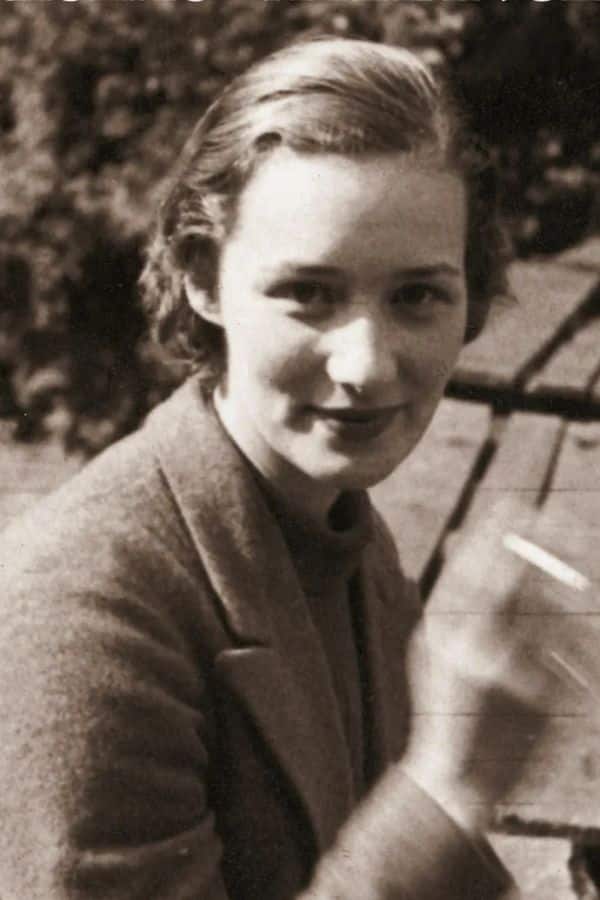
Marie-Madeleine’s first mission was to create sections across unoccupied France, then recruit and assign agents to each section. She was barely 30 years old, with two young children, building an espionage network from scratch. As the network grew, it became known as Alliance.
Marie-Madeleine came up with the idea of using animal code names, and every agent got one. The men chose powerful names such as Wolf, Lion, Tiger, Elephant, Bull, and Eagle. Marie-Madeleine chose Hedgehog, small and unthreatening in appearance. But as a friend of hers put it, “a tough little animal that even a lion would hesitate to bite.” The Gestapo started calling them Noah’s Ark because of all the animal names. The name stuck.
In July 1941, just over a year after the German invasion, the Vichy police arrested Navarre. He was sentenced to two years in prison. Before they took him away, he made it clear that Marie-Madeleine would take over and lead Alliance. When MI6 sent a cable asking who would be running the network now, Marie-Madeleine’s response was simple. “I am.”
Hooked on the Middle Ages? Get more stories like this one in your inbox.
What Alliance Actually Did
Alliance infiltrated every major port and sizable town in France, growing to 3,000 agents at its peak. They came from every segment of society: military officers, government clerks, architects, shopkeepers, fishermen, housewives, doctors, artists, plumbers, students, bus drivers, priests, and members of the aristocracy.
And thanks to Marie-Madeleine’s efforts, almost 20 percent of Alliance agents were women. The highest number of any resistance organization in France.
They Tracked German Submarines
Jacques Stosskopf worked at the German submarine base at Lorient, the largest in the world, and the French despised him as a collaborator. He was so diligent in his work for Admiral Karl Dönitz that no one suspected he was feeding information to the Alliance.
German U-boats were decimating British merchant shipping, and as Britain imported 70 percent of its food, this had to be stopped. Stosskopf sent detailed intelligence about submarine locations, sailing schedules, and operations to MI6 so they could destroy German subs and break the blockade.
They Intercepted Secret Weapons Programs
Jeannie Rousseau was young, pretty, and spoke perfect German. She befriended Wehrmacht officers at parties, fluttered her eyelashes, and let them try to impress her by talking about their important work. One officer drew her a rocket and a testing station at Peenemünde, revealing Germany’s V-1 and V-2 terror weapons program.
She had a photographic memory, wrote it all down afterward, and passed it to Alliance. The intelligence reached the Allies, who bombed the manufacturing plants holding the weapons Hitler had hoped would prevent D-Day from happening. They didn’t.
They Provided the D-Day Map
Robert Douin was an artist and sculptor living in Normandy. He and his team sketched every single German fortification along the coast. Every gun emplacement, observation tower, minefield, coastal battery, barbed-wire fortification, and beach obstacle.
They created a hand-drawn map that was 55 feet long, showing the beaches and roads where the Allies would land on June 6, 1944. American and British military commanders used that map to plan the invasion. MI6 called it “a coup” because without it, D-Day casualties would have been catastrophically higher.
Sadly, the Nazis executed Douin as the Normandy invasion began.
They Stopped Rommel in North Africa
An Alliance customs agent in Marseille discovered guns and the sailing date for Rommel’s Afrika Korps heading across the Mediterranean. Radio operators transmitted the information to MI6.
British bombers destroyed the entire convoy before it reached North Africa. Germany never gained a foothold in the region, which meant they never controlled oil from the Middle East.
They Provided Invaluable Intelligence
The intelligence they provided covered everything from troop movements and defensive fortifications to ship sailings and supply lines for nearly four years. No other Allied spy network in France lasted as long or supplied as much crucial intelligence.
The Personal Cost For Members of Alliance
Marie-Madeleine moved her headquarters every few weeks, changed her hair color and clothing constantly, and her identity. She wore disguises, used false papers, and lived on the run. She had a displaced hip that forced her to walk with a pronounced limp, which should have made it easier for the Gestapo to track her. But somehow, she always managed to stay one step ahead of them, at least for a while.
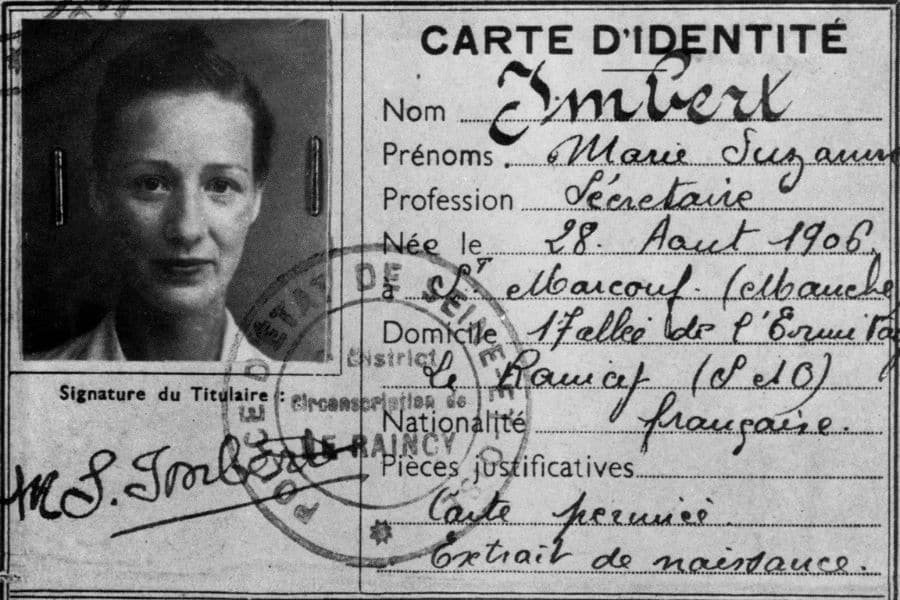
In November 1942, she was captured for the first time, arrested with her staff. But Vichy policemen who were secretly sympathetic to the resistance helped her escape. She was flown to London, where she continued directing the network from a house in Chelsea.
But she couldn’t stay in England while her agents were in France continuing the work she’d started; she needed to be there with them.
And then there was Léon Faye, whose code name was Eagle. He was her second-in-command, a French Air Force pilot, and somewhere along the way, Marie-Madeleine fell in love with him.
In June 1943, while hiding in Lyon, she gave birth to a son, Léon’s child. She was on the run because the Gestapo was hunting her. She couldn’t keep the baby with her, so she gave him to her assistant, Monique Bontionck, who hid him in a safe house in the south of France.
Marie-Madeleine’s two older children from her first marriage weren’t safe either. The Gestapo had put them on a wanted list, so she sent them to Switzerland. They were 12 and 10 years old.
Marie-Madeleine watched her children leave from a building in Lyon. She couldn’t say goodbye to them in case someone noticed and followed them. She watched from a distance, hoping and praying they would survive.
The escape route was blocked, and the frontier crawled with German patrols. Their only option was to make a run for it. The peasants who helped them pointed them toward where the barbed wire ran, miles away, and so they made their escape.
In September 1943, the Gestapo captured Léon Faye, and he was tortured and executed in January 1945, just months before the war ended. Marie-Madeleine never really recovered from losing him.
The Gestapo’s Relentless Hunt
For a year and a half, from 1943 through mid-1944, the Gestapo engaged in a full-scale offensive to destroy Alliance. Wave after wave of arrests followed by torture and executions. Entire regional sectors were wiped out, with hundreds of agents swept up and killed.
After each crackdown, the Gestapo was sure they’d finally destroyed the network. But Marie-Madeleine kept rebuilding it. Every time a regional circuit was decimated, she cobbled together a new one with new recruits, operatives, and channels of communication.
Claude Dansey of MI6 warned her. “You’ve gone on long past the safety limits. According to the law of averages, an underground leader can’t last more than six months.”
She’d been running Alliance for more than three years by that point. By the summer of 1944, she had no idea how many of her people were still alive. Dozens of her closest associates had been tortured and executed. Some died in concentration camps, while others were shot in the streets. The cost was staggering, but Alliance kept functioning.
After the Escape
After Marie-Madeleine squeezed through those prison bars in Aix-en-Provence, she made her way back to her network. Rural guerrilla fighters, the maquis, gave her a new identity and sent her to Marseille on a motorcycle. Operatives there dressed her in widow’s clothes and put her on a train to Paris.
She assembled what remained of her team, and they gathered intelligence about the Nazis still in the city. The Germans were planning a massive retreat, stealing every bicycle, car, and farm wagon they could find.
Alliance kept transmitting until Paris was liberated in August 1944.
Even after liberation, Marie-Madeleine continued, traveling to northeastern France to scout enemy positions for U.S. troops heading toward the German border. Alliance didn’t stop operating until the war in Europe ended in May 1945.
By then, more than 500 of her 3,000 agents were dead. The exact number is hard to pin down because records were destroyed, and some agents were never accounted for. Marie-Madeleine spent much of the rest of her life fighting for jobs, pensions, and medical care for the 3,000 Alliance survivors and their families.
Forgotten by History
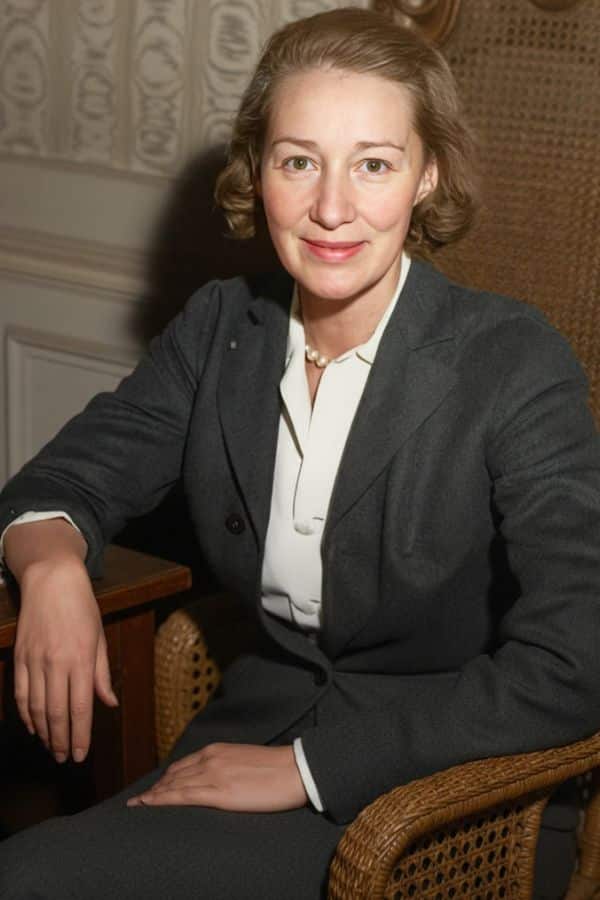
Despite everything Alliance accomplished, Charles de Gaulle did not include Marie-Madeleine among the 1,038 people he designated as resistance heroes after the war. That list included only six women total, and Marie-Madeleine wasn’t one of them.
Her husband, Édouard Méric, received the Order of the Liberation, but she didn’t. She was the only woman to head a major French resistance network throughout the war, yet she was excluded from official recognition.
Why? Politics. She refused to take sides in the power struggles between rival French resistance groups after the war. She remained loyal to her British intelligence handlers, which annoyed the French intelligence service. And some early Alliance members had been part of the Vichy government, which became a permanent stain on the network’s reputation.
She remarried after the war, and her second husband, Hubert Fourcade, adopted Léon’s son and raised him alongside their three children together. Marie-Madeleine had five children in total by the end of her life. She remained active in veterans’ organizations, chairing multiple committees. She fought for years to get Klaus Barbie, “the Butcher of Lyon,” convicted for war crimes, and finally saw that happen in 1987.
She wrote a memoir in 1968 called L’Arche de Noé (Noah’s Ark), which became a bestseller in France. But even in her own book, she remained intensely private about her personal life. She barely mentioned her children and never fully opened up about Léon Faye or the cost of choosing her country over her family.
Marie-Madeleine Fourcade died on July 20, 1989, at age 80, in the military hospital of Val-de-Grâce in Paris. The government and surviving members of Alliance paid her an exceptional tribute at her funeral in the Église Saint-Louis des Invalides. She was the first woman to have her funeral there and was buried in the Cimetière du Père-Lachaise.
Streets in Lyon, Montreuil-Juigné, Joué-lès-Tours, and Malville were named in her honor. But for decades, most people had no idea who she was or what she’d done.
Marie-Madeleine Fourcade ran the longest-lasting and most effective Allied spy network in occupied France. She commanded 3,000 agents, provided the 55-foot map that helped make D-Day possible, and gave the Allies intelligence on German U-boats, V-1 and V-2 rockets, troop movements, and defensive fortifications, saving thousands of lives and shortening the war.
She was captured twice by the Nazis and escaped both times.
She sent her children away to keep them safe. gave birth to a son while on the run and immediately gave him up to protect him. She lost the man she loved to Gestapo torture and execution. And she kept going.
Marie-Madeleine chose Hedgehog as her code name for a reason. Small and unthreatening on the surface, but when challenged, a hedgehog rolls into a ball with all its spines pointing outward.
Her story deserves to be remembered as one of the most remarkable leaders of World War II.

Love a good medieval story?
Join our readers and get tales of kings, queens, castles and ordinary medieval lives straight to your inbox.
Kylie Lang is a nationally syndicated travel journalist with bylines on the Associated Press Wire & more, a medieval history writer, and the founder and lead author of Tales of the Middle Ages (talesofthemiddleages.com). She holds a BA (Honours) in History from the University of Kent and is a member of the British Guild of Travel Writers.
Related posts:
 Vera Atkins, Legendary Spymaster of the SOE Turned Nazi Hunter
 Virginia Hall: The American Spy the Gestapo Couldn’t Catch Who Helped Win World War II
 The Poison Plot That Shook Paris: The Execution of Madame Marie de Brinvilliers
The Scandal of the Marquise de Brinvilliers Murders: The Poison Plot That Shook Paris
The Poison Plot That Shook Paris: The Execution of Madame Marie de Brinvilliers
The Scandal of the Marquise de Brinvilliers Murders: The Poison Plot That Shook Paris