Born in England but living in France, I am fascinated by the history of these two countries. It feels like these two countries have been at each other’s throats for centuries. Even now, my lovely French neighbours and I tease each other about the rivalry between our countries. They are all friendly, I hasten to add.
In all seriousness, though, these two countries fought tooth and nail over the years, and some of their most brutal battles defined the course of history. From the muddy fields of Agincourt to the bloody streets of Crécy, these clashes were full of military strategy, honor, power, and survival. Here are the five most brutal battles between England and France in the Middle Ages.
Table of Contents

1. The Battle of Agincourt (1415): A Victory Against the Odds
The Battle of Agincourt was a bloodbath and a decisive battle in the Hundred Years’ War. On October 25, 1415, St. Crispin’s Day, Henry V’s exhausted and outnumbered army faced tens of thousands of well-armed French troops. The English had just limped through northern France, plagued by dysentery and battered from marching through autumn rain. They were hungry, filthy, and in no shape for a fight.
The French, on the other hand, were confident. Too confident. They had the numbers, the knights, and the home advantage. But they also had a problem: the battlefield. Narrow, freshly ploughed farmland, hemmed in by woods, had turned to a thick slop of mud from days of rain. Perfect for slowing down heavily-armored men on horseback. A nightmare for movement.

Henry used it to his advantage. He lined up around 6,000 men, most of them archers, behind sharpened wooden stakes. When the French charged, they got stuck. Literally. The mud sucked them down as English arrows rained from above. Those who made it to the English lines were quickly cut down by lightly armed men with daggers, axes, and hammers.
In the chaos, thousands of French nobles and soldiers died, many crushed in the melee. Some estimates put French casualties at over 6,000, including dozens of high-ranking nobles. The English lost fewer than 500. It was so brutal that Henry ordered the execution of hundreds of French prisoners, fearing they’d rise up again mid-battle.
2. The Battle of Crécy (1346): A Game-Changer for Medieval Warfare
The Battle of Crécy is often seen as one of the most decisive in the Hundred Years’ War. It was August 26, 1346, and King Edward III of England had just finished raiding his way through northern France. His army took up a defensive position near the village of Crécy. They were outnumbered by a French force that likely doubled their size, maybe more.
But Edward had a secret weapon: longbowmen. Thousands of them.

The English dug in on a slope, creating a killing field below. When the French attacked, they did so in waves, led by heavily armored knights who expected to smash through the English lines. Instead, they galloped straight into a storm of arrows. The longbow could pierce armor from 200 yards. It was carnage.
French horses bucked, blinded by arrows and crashing into one another in the mud. Fallen knights were trampled by their own men. The Genoese crossbowmen hired by the French king barely got a shot off before being mown down, or killed by their French allies for retreating.
Crécy was a disaster for France. Up to 10,000 French soldiers were killed, many of them nobles. The English lost only a few hundred.
Hooked on the Middle Ages? Get more stories like this one in your inbox.
3. The Battle of Poitiers (1356): A Staggering English Victory
Just a decade after Crécy, the English were back at it. 1356 Edward, the Black Prince, led the English forces in the Battle of Poitiers. France’s King John II wasn’t having it. He gathered a huge army to crush the English and restore some dignity. On paper, he had every advantage: numbers, position, and the belief that surely lightning wouldn’t strike twice.
It did.
The battle unfolded on September 19, 1356. Outnumbered and low on supplies, the English chose their ground wisely; dense hedgerows, narrow lanes, and gently sloping terrain funneled the French into chaos. English longbowmen once again played their deadly part, cutting down waves of knights before they could reach the front lines.

The French cavalry kept charging anyway, trying to break through. But it was a disaster. Horses stumbled. Armor clanged. Arrows rained. And then came the final blow: the French front collapsed under pressure from a surprise English counterattack. The elite were either dead or scrambling for cover.
In the chaos, King John II was surrounded. Refusing to flee, he fought bravely but was captured alongside his youngest son. Imagine the humiliation: a crowned monarch held prisoner by a foreign army. He was treated well by his English captors, but his capture triggered a full-blown crisis in France. The ransom alone was astronomical, set at 3 million écus.
4. The Battle of Bouvines (1214): A Turning Point for the English
Before the Hundred Years’ War even began, there was the Battle of Bouvines in 1214. On July 27, 1214, the fields near the village of Bouvines saw one of the most decisive medieval clashes in western Europe. King John of England had cobbled together an alliance with the Holy Roman Emperor Otto IV and rebellious French nobles. The goal? Crush Philip II of France and reclaim the rich French territories John had lost, including Normandy.
But everything went wrong.
Philip, facing a coalition army nearly double his size, held his ground. The battle unfolded on a hot summer Sunday, with knights in gleaming armor charging into one of the last great melee-style battles of the Middle Ages. No clever terrain. No archer lines. Just brutal cavalry charges, hand-to-hand chaos, and the thunder of horses pounding across open fields.
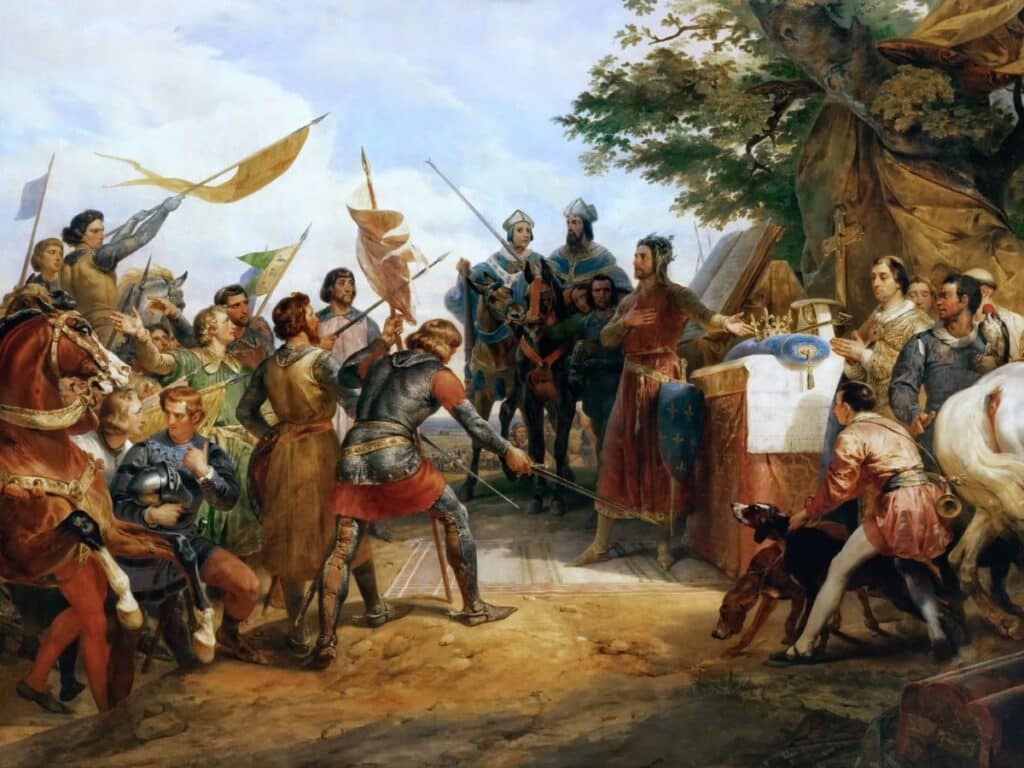
Philip fought like a commander with everything to lose, and he almost did. At one point, he was unhorsed and barely escaped capture. But the French regrouped fast, and their disciplined counterattack sent the coalition forces reeling. Otto IV fled the field in disgrace. French forces captured hundreds of enemy knights, and John’s plans crumbled.
The aftermath was catastrophic for England. John was humiliated. His remaining grip on French territories slipped further through his fingers. Back home, his barons turned against him, setting the wheels in motion for the Magna Carta just a year later.
It ended England’s continental dominance and gave France the momentum it would carry into the next century of rivalry.
5. The Battle of Hastings (1066): A Shocking English Invasion
The Battle of Hastings took place on October 14, 1066, and it came from across the Channel. William, Duke of Normandy, believed he had a rightful claim to the English throne. So he built a fleet, gathered thousands of men, crossed the sea, and launched a full-scale invasion.
King Harold II of England had just finished repelling a Viking invasion in the north when word came that William had landed. Harold marched his tired army south and took position near Hastings. The English formed a solid shield wall, strong and unmoving. For hours, they held off Norman cavalry and archers.
Then William got clever.
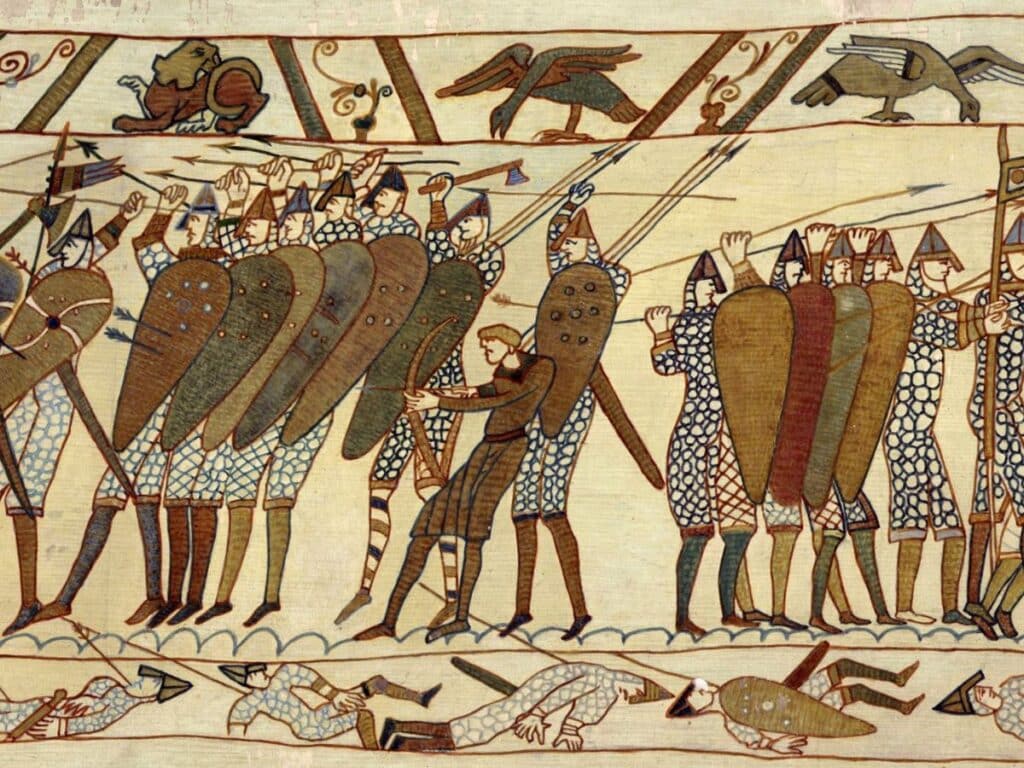
He feigned a retreat, luring part of the English line down the hill. It broke their formation, and that’s when the Normans struck hard. Harold was killed, legend says it was an arrow to the eye, and his death shattered English resistance.
The victory gave William control of England. But it did more than change who wore the crown. It rewired the English ruling class, law, language, and culture. French nobles replaced Anglo-Saxon ones. The elite spoke Norman French for centuries.
William the Conqueror became King of England.

The Impact of Strategy: How Tactical Innovations Changed the Course of Battle
The battles between England and France were often decided by strategic thinking that transformed medieval warfare more than brute force. Take the Battle of Crécy, for instance, where Edward III’s use of longbowmen redefined the battlefield.
Instead of relying solely on heavy cavalry, Edward’s army employed long-range archers, decimating the French knights before they even reached the English lines. Similarly, at Agincourt, Henry V utilized terrain and positioning to neutralize the French advantage.
These tactical innovations not only led to significant victories but also forced both sides to rethink how wars were fought.
These battles showed that in medieval warfare, the smart use of resources, like archers and terrain, could often be more decisive than the size of an army. The legacy of these strategies continues to shape modern warfare today.

The Aftermath: A Rivalry that Never Dies
While the battles may have ended, the political and cultural fallout from these clashes still reverberates today. Trust me, as a Brit living in France, I’m only too well aware of it. Whether in the arts, politics, or sports, England and France’s competitive spirit remains a defining feature of their relationship.
The Enduring Legacy of the English-French Rivalry
The brutal battles between England and France were defining moments that reshaped nations. From the tactical genius at Agincourt to the devastating losses at Poitiers, each battle left a lasting mark on the course of history.
Love a good medieval story?
Join our readers and get tales of kings, queens, castles and ordinary medieval lives straight to your inbox.

Kylie Lang is a nationally syndicated travel journalist with bylines on the Associated Press Wire & more, a medieval history writer, and the founder and lead author of Tales of the Middle Ages (talesofthemiddleages.com). She holds a BA (Honours) in History from the University of Kent and is a member of the British Guild of Travel Writers.
Related posts:
 The Battle of Crécy 1346: How a Teenage Prince and a Wall of Arrows Brought France to Its Knees
 William Marshall, the Greatest Knight Who Ever Lived. But Who Was the Man Behind the Legend?
 The Hundred Years War Battles That Broke France: Mud, Blood, Dysentery, and a King Taken Hostage
 Must-Read Books on the Hundred Years War. These Page-Turners Nail It