
A brand new documentary aired on the UK’s Channel 4 this weekend, featuring the DNA taken from a swatch of fabric with Hitler’s blood extracted from the sofa where he killed himself. Now, if that doesn’t get your attention, nothing will. I was excited to watch, having studied the history of both World Wars at A-level when I was in school.

Would it answer the question of whether Hitler had Jewish blood? Was there more to the dictator’s DNA that might have led to other things, such as Schizophrenia?
Table of Contents
And then, of course, the ever-debated topic of his nether regions. We all knew the song at school about Hitler only having one ball. Was it true, or simply a great song the Allies sang to boost morale? Let’s find out.

Could This Really be Hitler’s DNA?
The first question anyone asks is whether the sample is genuine. If the blood is not Hitler’s, the entire investigation collapses before it even begins. Authenticity matters because so many stories about Hitler’s body grew out of rumor and wartime propaganda. A confirmed biological sample cuts through all of that and gives researchers something solid to work with.
The fabric that carried the blood started its journey inside the Berlin bunker in the final hours of the war. When Soviet troops reached the underground complex in 1945, they were the first to see the damage, the bodies, and the blood-soaked furniture. The sofa where Hitler died was still in place. Reports describe blood on the seat and spray patterns across the wall.
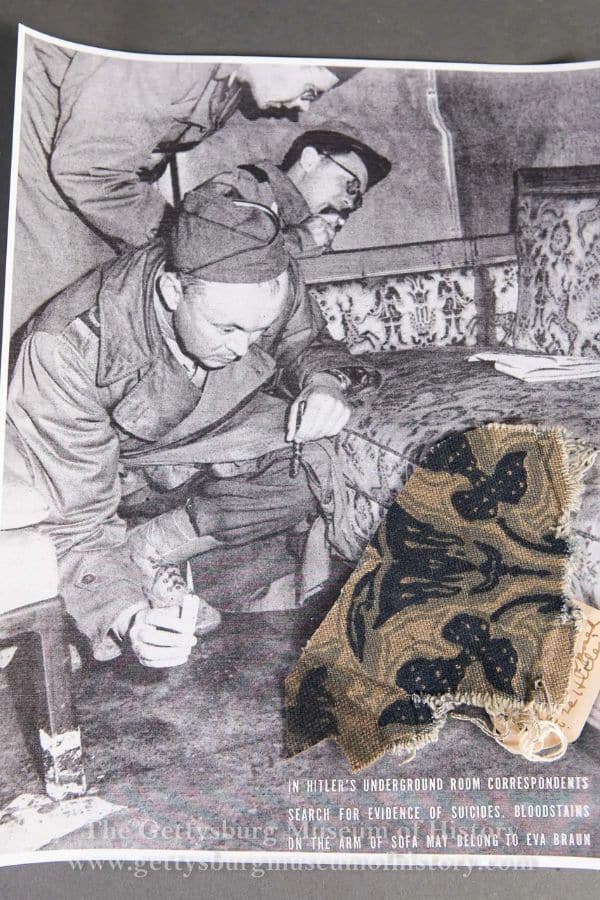
Not long after the Soviets secured the bunker, a small group of American officers was allowed inside. One of them was Colonel Roswell P Rosengren, the communications officer for General Dwight D Eisenhower. According to the documentary, Rosengren was shown the room where Hitler and Eva Braun were found. Photo Credit: Gettysburg Museum of History https://www.gettysburgmuseumofhistory.com/hitlers-dna-how-a-battlefield-souvenir-modern-genetics-and-eight-years-of-testing-finally-settled-two-of-historys-most-persistent-myths/
He noticed the bloodstained couch and cut away a small square of fabric as a relic. He took the swatch home after the war. It stayed with his family for decades, tucked away as an unusual keepsake from a world that had collapsed. In 2014, the family decided to sell it at auction.
The Gettysburg Museum of History in Pennsylvania purchased it and added it to its collection of wartime artifacts. It sat there quietly for years until researchers asked for access, hoping it still held biological traces of the man who unleashed devastation across Europe.
This chain of custody is one of the main reasons scientists take the sample seriously. It links a specific piece of fabric from a specific location to a documented timeline that has not changed since 1945. It does not prove authenticity beyond all doubt, but it builds a strong case before the science even begins.
The Journey of the Bloodstained Fabric
The swatch is a small piece of upholstery with worn fibers and visible discoloration from old blood. Time has softened the material, but enough texture remains to show that it once came from furniture meant for heavy use. It carries the kind of age you see in objects that have lived through far more than their size would suggest.
After the war, although it remained within the Rosengren family, it was neither archived nor treated as a scientific sample. It was simply stored like many wartime relics that families hold on to for personal reasons. The lack of interference means the fabric was not scrubbed or preserved with chemicals that might have damaged any biological traces.
When the family sold it to the Gettysburg Museum of History, they added it to a collection of artifacts from major conflicts. Institutions like this often collect unusual relics because they represent the physical and human aspects of events that have shaped the modern world. These objects help museums tell stories that cannot be conveyed through documents alone.
Once the fabric was cataloged, it remained in the museum’s care until researchers began looking for original material linked to the bunker. The swatch stood out as a rare surviving object with potential scientific value, which led to its role in the documentary’s investigation.

How Scientists Extracted the DNA
Working with a piece of fabric from 1945 is far from straightforward. Old cloth retains dirt, dust, sweat, and any other substances it has come into contact with over the years. Blood can cling to the fibers, but the genetic material inside it breaks down over time. Scientists must tease out whatever remains without introducing new contamination, which is one of the biggest hurdles in this type of work.
Professor Turi King was at the helm of the investigation. She built her reputation on the identification of King Richard III, a project that required her to extract usable DNA from centuries-old remains buried beneath a parking lot.
That work demanded precision, patience, and a deep understanding of how to authenticate samples that most scientists would consider beyond saving. Her background made her an ideal choice for this investigation because she already knew how to work with degraded material and how to build a solid case that links genetic evidence to a historical figure.
To start, King and her team examined the stained section under controlled laboratory conditions. They looked for dried blood that had seeped deep enough into the fibers to offer something more than surface residue. Once they identified the right areas, they used a method that lifts microscopic fragments of blood from the weave.
Old samples are often degraded, which means the strands of genetic material can be incomplete or fragile. King’s team used modern amplification techniques to strengthen the fragments that survived.
They then checked the sequences to see whether they formed a pattern that matched human DNA rather than environmental contamination, such as bacteria or mold. Only once the team confirmed they were working with viable human material did they move forward.
The next step was comparison. Scientists located a verified living relative of Adolf Hitler, someone whose family line could be traced with documented certainty. They examined specific genetic markers in both samples to see whether they aligned in a way consistent with close kinship.
The match strengthened the case that the blood on the fabric belonged to Hitler. This kind of comparison is important because it links the sample to a known genetic line rather than relying only on the fabric’s history or the word of previous owners.
What Did Hitler’s DNA Reveal About the Man?
The most unexpected finding in the analysis was a mutation in a gene called PROK2. This gene plays a role in the development of the body’s hormone system. Specific mutations in PROK2 are linked to a condition known as Kallmann syndrome. The condition affects the signals that tell the body to begin puberty, which can lead to delayed development or no puberty at all.
Kallmann syndrome can influence physical growth in several ways. Boys with the condition often have very low testosterone. This can result in limited facial hair, reduced muscle development, and a higher likelihood of undescended testicles. In a small number of cases, it’s also linked to a tiny but typically formed penis. The condition can also affect the sense of smell, a trait sometimes noted in medical descriptions.
These details touch on rumors that have followed Hitler for decades. Stories about an undescended testicle appeared as early as the 1920s. Wartime songs and jokes exaggerated the idea, turning it into propaganda rather than a medical question.
The DNA does not turn those rumors into confirmed truth, but it does offer a biological route that makes them more understandable. Kallmann syndrome fits with some of the physical descriptions recorded long before the documentary was made.
This does not excuse or explain anything about Hitler’s choices or actions. It simply adds a medical layer to a figure who has often been discussed in extremes. The genetic finding shows how science can cut through decades of myth and present information that is factual rather than sensational.
Questions About Ancestry and Mental Health
The documentary also examined two long-standing questions. Did Hitler have Jewish ancestry, and did his DNA show any sign of a predisposition to mental illness? These topics have circulated for decades, shaped primarily by rumor, political agendas, and the need to explain how a single person could have driven such widespread destruction. The researchers approached them with genetic tools rather than speculation.
Tracing ancestry through DNA involves looking for markers that indicate specific population groups. These markers do not identify religion or cultural identity. They simply show whether a person shares genetic patterns more common in one region than another.
The team searched for markers that might support the claim that Hitler had Jewish ancestors. The results did not show a clear link. They did not rule it out either. The DNA sample is small, and ancestry studies usually require a more comprehensive genetic map. For now, the question remains open.
The researchers also sought signs that might indicate specific mental health conditions. Some disorders have known genetic components, although genes alone cannot predict behavior. The team examined regions of the recovered DNA that are associated with conditions like schizophrenia and depression. The results did not show strong indicators in either direction. The sample was too limited to draw a confident conclusion, and the science in this area is still in development.
What the documentary makes clear is that DNA can offer clues, but it cannot provide a complete psychological profile of any person, living or dead. Genetics can highlight risk factors, but it cannot explain motives, beliefs, or actions. Science can support discussions about health and ancestry. Still, it cannot rewrite history or serve as a shortcut to understanding a person whose impact came from ideology, opportunity, and choices rather than biology.
The Limits of the Evidence
The documentary presents striking claims, but none of the findings have been peer reviewed. This is the first major limit. Until a scientific journal evaluates the work, other researchers cannot study the methods or test the conclusions for themselves.
Peer review matters because it forces a study to withstand scrutiny from individuals who have no vested interest in the outcome. It is the difference between a promising idea and a verified scientific result.
Without that independent review, several things remain unproven. The DNA may well come from Hitler, but confirmation depends on whether the sample survives full academic inspection. The genetic links to certain conditions, including the mutation associated with Kallmann syndrome, also need to be checked by specialists who can rule out contamination or sequencing errors. Even the comparison to a living relative, which strengthens the case, still requires outside verification.
Experts who have not worked on the project tend to take a cautious approach. They acknowledge that the chain of custody is strong enough to justify serious interest. At the same time, they point out that extraordinary claims need equally firm evidence. Until the study is published and reviewed, the findings sit in a middle ground. They are intriguing, but they are not confirmed facts.
This does not mean the work is without value. It means the story is not finished. The next stage depends on whether the research can withstand the kind of pressure that every major scientific claim must face.


Kylie Lang is a nationally syndicated travel journalist with bylines on the Associated Press Wire & more, a medieval history writer, and the founder and lead author of Tales of the Middle Ages (talesofthemiddleages.com). She holds a BA (Honours) in History from the University of Kent and is a member of the British Guild of Travel Writers.
Related posts:
 Unearthing the Last Plantagenet King: The Story of How Richard III Was Found After 500 Years
 16 Million Descendants Later Genghis Khan Changed the World But His Legacy Has Nothing To Do With DNA
Genghis Khan had 16 Million Descendants and Counting, But Here’s What They Don’t Teach You About Him
16 Million Descendants Later Genghis Khan Changed the World But His Legacy Has Nothing To Do With DNA
Genghis Khan had 16 Million Descendants and Counting, But Here’s What They Don’t Teach You About Him
 The Curse of Tutankhamun: A Medieval Myth or Ancient Reality?