
In April 1805, a teenage girl set out from Fort Mandan with a newborn strapped to her back and a husband who’d been hired largely because she came with him. She was Shoshone, kidnapped years earlier by a Hidatsa raiding party, and sold or gambled away to a French Canadian trader named Toussaint Charbonneau. She was around 17. The baby was two months old.
The expedition she joined would become the most famous overland journey in American history. The men leading it, Meriwether Lewis and William Clark, were soldiers and surveyors with rifles, sextants, and orders from Thomas Jefferson. What they didn’t have was a way to talk to the people whose land they were about to cross, or any horses to cross it on once the rivers ran out.
Table of Contents
That’s where Sacagawea came in. But her story isn’t the fairytale of a woman looking into the distance with a baby on her hip, far from it. Her reality was not romantic in the slightest. She walked into her own past, negotiated with a brother she hadn’t seen since childhood, and kept a party of armed white men alive in a country where their presence alone could’ve gotten them killed.
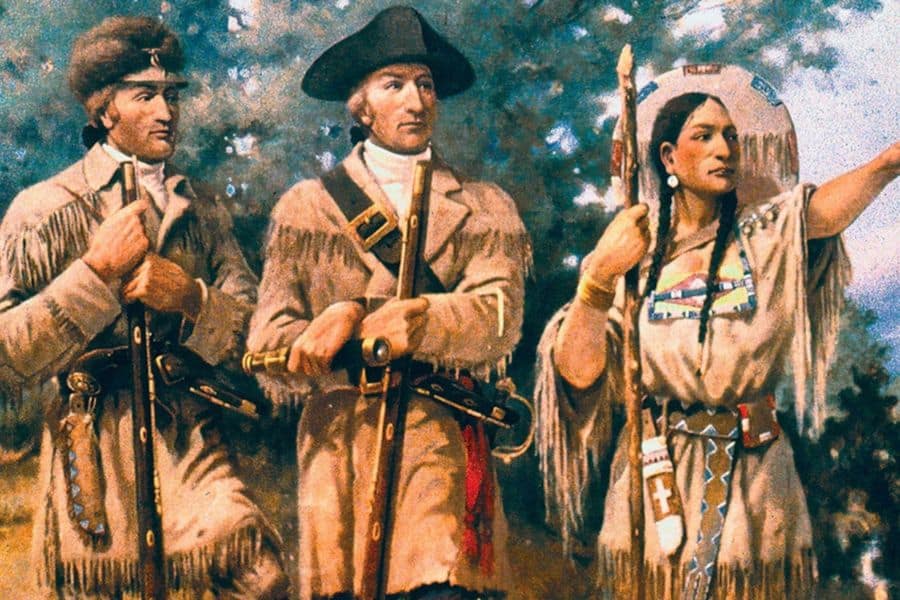
How a Shoshone Girl Ended Up on the Missouri
Sacagawea was born around 1788, somewhere in the Lemhi River country of what’s now Idaho. Her people, the Lemhi Shoshone, lived in the mountains in summer and crossed east over the Continental Divide to hunt buffalo on the plains. It was on one of those buffalo hunts, around 1800, that her life broke in half.
A Hidatsa war party attacked the Shoshone camp near the Three Forks of the Missouri. Sacagawea, perhaps 12 years old, was captured along with several other girls and boys. The Hidatsa took her hundreds of miles east to their villages on the Knife River in present-day North Dakota.
There she lived as a captive for the next several years, learning Hidatsa, doing the labor of a slave, and eventually being handed over to Charbonneau, who already had at least one other Shoshone wife taken the same way.
When Lewis and Clark wintered at Fort Mandan in 1804-05, they hired Charbonneau as an interpreter because he spoke Hidatsa and a little French. The real reason he got the job, though, is in the journals: his wife spoke Shoshone, and the captains knew they’d need Shoshone horses to cross the Rockies.
She was pregnant when they made the decision. She gave birth to her son, Jean Baptiste, in February 1805, in a difficult labor that Lewis recorded in some detail. Two months later, baby on a cradleboard, she walked out of the fort with around 30 men and headed upriver.
Hooked on the Middle Ages? Get more stories like this one in your inbox.
What She Actually Did on the River
As with so many myths, a story gets in the way of the facts. In this story, the geography was all wrong. Sacagawea wasn’t guiding the expedition through territory she knew well. For most of the Missouri stretch, she was a captive being carried back through country she’d last seen as a frightened girl. The men were the ones with the maps, such as they were.
What she did do, day to day, was keep them fed and keep them out of fights. She dug prairie turnips and wild artichokes and fennel root, food the soldiers couldn’t have found on their own.
In May 1805, when a sudden squall nearly capsized one of the pirogues, it was Sacagawea, sitting in the stern with her baby, who calmly fished the floating journals, instruments, and medicines out of the water as Charbonneau panicked at the rudder. Lewis named a river after her a few days later. He spelled it Sah-ca-gah-we-a and called her a woman of fortitude and resolution.
Then there was the simple fact of her presence. A war party traveled without women and children. A Shoshone woman with an infant, walking openly with a group of armed men, told every band that watched them from the bluffs that this was something else, a trading party, maybe, or at least not a raid.
Clark wrote it down plainly in October 1805: the wife of Shabono, our interpreter, we find reconciles all the Indians as to our friendly intentions. A woman with a party of men is a token of peace.

The Reunion at Camp Fortunate
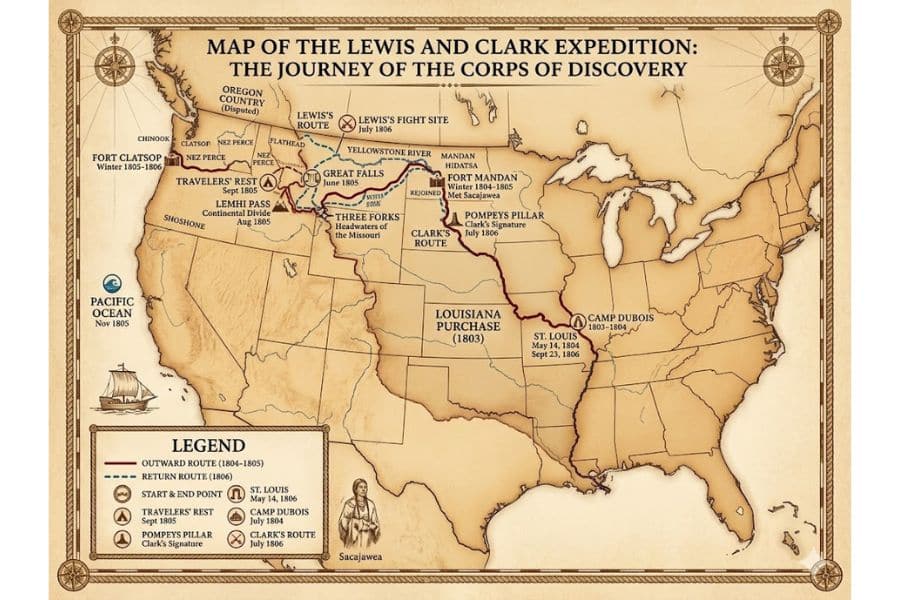
By August 1805, the expedition was at the headwaters of the Missouri and in trouble. The rivers were running out, and the Rockies were ahead. Without horses, they were finished. Lewis went ahead with a small party to find the Shoshone, and after days of near misses, he finally made contact with a band led by a chief named Cameahwait. He brought them back to where Clark and Sacagawea were waiting with the rest of the men.
What happened next is one of the strangest scenes in American exploration writing. Sacagawea was called in to interpret. She sat down, looked at the chief, recognized him, and began to weep. Cameahwait was her brother. She threw her blanket over him and cried, and then she had to pull herself together and do the job, because the entire expedition turned on this conversation.
The translation chain was absurd. Cameahwait spoke Shoshone to Sacagawea. She translated to Hidatsa for Charbonneau. He translated the Hidatsa into French for a private named Francois Labiche. Labiche translated the French into English for Lewis and Clark.
Every question and every answer ran that gauntlet, with a teenage girl who’d just found her surviving family at one end of it. And the question on the table was whether the Shoshone would sell the Americans the horses they needed to cross the mountains, or take everything they had and leave them to starve.
The Horse Negotiations and What She Overheard
Cameahwait was inclined to help. His sister was back, the strangers had goods to trade, and the Shoshone needed guns. But the Shoshone were also starving, late for their own buffalo hunt, and growing restless.
At one point during the negotiations, Sacagawea overheard her brother quietly giving orders to break camp and head east to the plains. If the band left, the expedition lost its horses and its guide over the Divide.
She told Lewis, and he confronted Cameahwait. The chief admitted it, agreed his obligation to the strangers came first, and countermanded the order, and the expedition got its horses. Roughly 29 of them, plus a guide called Old Toby, who took them over Lemhi Pass and into the worst stretch of the entire journey, the Bitterroot crossing in September snow, where they came close to starving to death and ended up eating colt meat and candle tallow.
Without that overheard conversation, the Bitterroot crossing never happens. Without the horses, neither does the descent to the Clearwater, the Snake, the Columbia.
The Vote at the Pacific and the Long Walk Home
By November 1805, the expedition reached the Pacific. They needed to decide where to winter, and Clark put the question to a vote. Every member of the party got a say, including York, Clark’s enslaved manservant, and it included Sacagawea.
Her vote is recorded: she wanted to camp where there were plenty of wapato roots to eat. They built Fort Clatsop on the south side of the Columbia, near her preferred ground.
In January 1806, a whale washed ashore, and the men went to see it and salvage its blubber. Sacagawea, who had walked thousands of miles with an infant, asked to come along. Clark recorded her argument: she’d traveled a great way, she’d not yet seen the great waters, and she hadn’t seen the monstrous fish either, and it seemed hard she couldn’t be allowed to see either, and he let her come.
On the return journey in 1806, she did finally guide. Crossing the Bozeman Pass area in what’s now Montana, she remembered the country from childhood and pointed Clark to the right gap in the mountains. He called her his pilot. They reached St. Louis in September. Charbonneau was paid around $500 and given land. Sacagawea was paid nothing.
What Happened After, and What We Don’t Know
The standard account says Sacagawea died of putrid fever at Fort Manuel on the Missouri in December 1812, at around 24 or 25 years old. A clerk named John Luttig wrote in his journal that the wife of Charbonneau, a Snake squaw, died that day.
Clark, who had grown fond of Jean Baptiste and offered to raise him in St. Louis, later wrote a list of expedition members and marked Sacagawea as dead. Most historians accept this.
A separate Shoshone oral tradition, recorded in the early 20th century, says she left Charbonneau, traveled for decades among the Comanche and other Plains peoples, and died on the Wind River Reservation in Wyoming in 1884 at a great old age.
The historian Grace Hebard championed this version in the 1930s, and it’s why there’s a grave marked for her at Wind River. Most academic historians lean toward the 1812 date. What isn’t in doubt is what she did between April 1805 and September 1806.

Love a good medieval story?
Join our readers and get tales of kings, queens, castles and ordinary medieval lives straight to your inbox.

Kylie Lang is a nationally syndicated travel journalist with bylines on the Associated Press Wire & more, a medieval history writer, and the founder and lead author of Tales of the Middle Ages (talesofthemiddleages.com). She holds a BA (Honours) in History from the University of Kent and is a member of the British Guild of Travel Writers.
Related posts:
 How Lady Worsley Turned Her Husband’s Humiliation into High Society Infamy
 The Curse of Tutankhamun: A Medieval Myth or Ancient Reality?
How Lady Worsley Turned Her Husband’s Humiliation into High Society Infamy
 The Battle of Crécy 1346: How a Teenage Prince and a Wall of Arrows Brought France to Its Knees