Off the coast of Cádiz, in the shallow waters where Spain’s old treasure fleets used to limp home, divers have found a wreck bristling with 27 cannons and a hold that once carried silver.
Ships like this one, lost somewhere between the Americas and the Casa de la Contratación in Seville, are scattered along the Atlantic floor in numbers that still surprise marine archaeologists. Each one is a small disaster, a crew drowned, a cargo gone, a ledger somewhere in Spain adjusted.
Table of Contents
What I find more interesting is what would have happened if the ship had made it. Because the silver that did arrive, year after year, fleet after fleet, didn’t rescue Spain. Instead, it helped break her. The Cádiz wreck is a useful place to start a longer story about where all that American silver went, who dug it out, and why the richest empire in Europe spent the 17th century going broke.
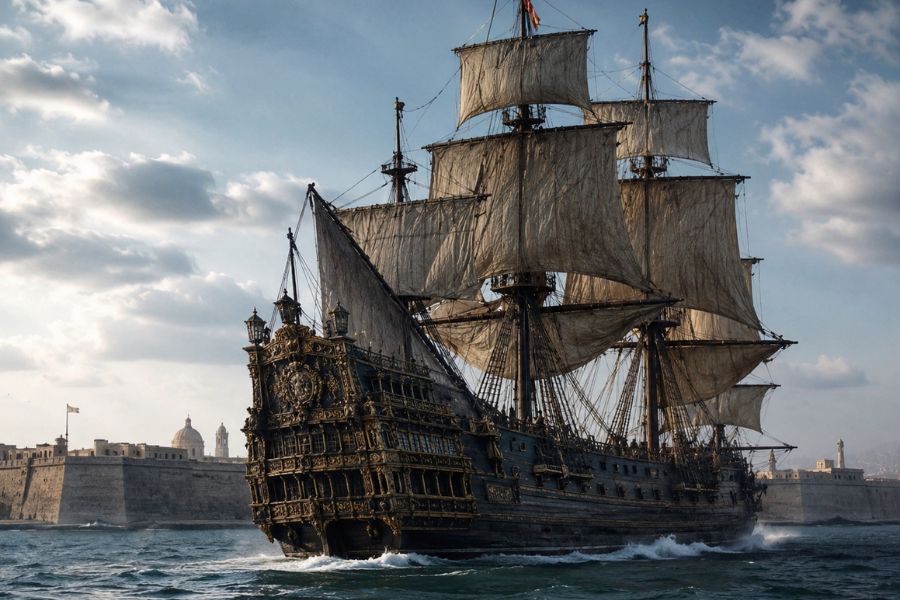
The Wreck Off Cádiz
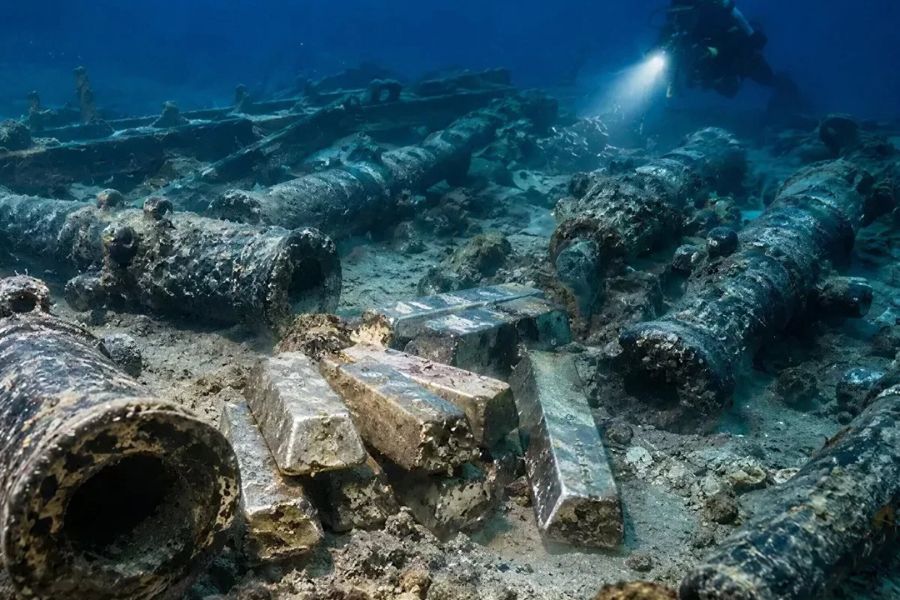
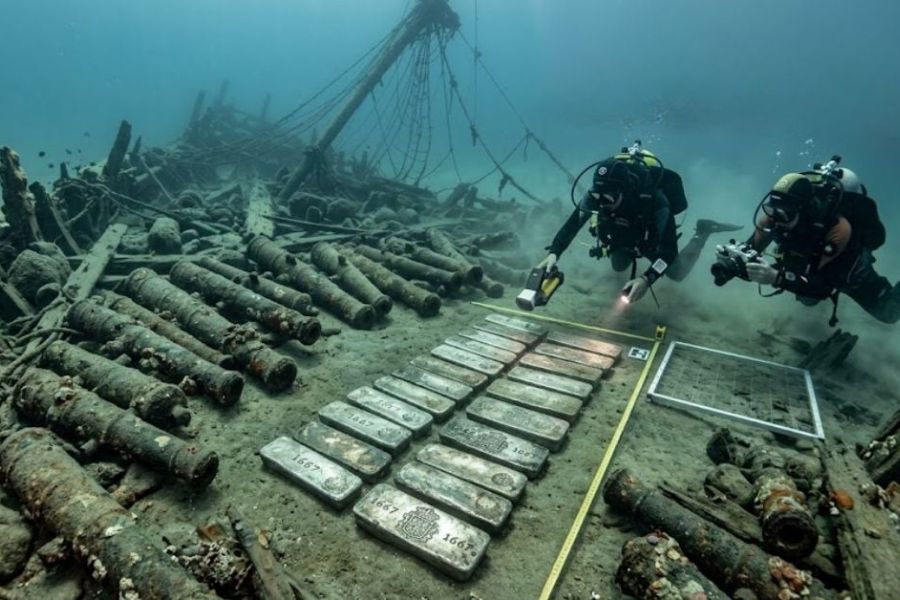
The site sits in shallow water near the mouth of the Bay of Cádiz, the same approach Spanish ships had been making since the 16th century. Divers from a joint Spanish team logged 27 iron and bronze cannons, scattered ballast stones, and silver coins fused into clumps by centuries of saltwater.
Early reporting in heritage outlets in May 2026 placed the vessel as an armed merchantman or a smaller warship escorting a returning convoy, though firm identification will take years.
Cádiz makes sense as a graveyard. After 1717, the official New World trade shifted from Seville to Cádiz, and the bay became the choke point for everything coming in from Veracruz, Cartagena, and Portobelo.
Storms, English raiders, Dutch privateers, and simple navigational errors picked off ships within sight of the harbor walls. Sir Francis Drake had already burned 30-odd vessels in the bay in 1587, the famous singeing of the King of Spain’s beard. The waters around Cádiz have layers of wrecks, the way old battlefields have layers of bone.
A cargo of silver going down within a few miles of home was the kind of loss that made bureaucrats in Seville weep into their ledgers. Each chest represented a chain of labor and violence that stretched back to a mountain in the Andes, and a system that depended on those chests arriving on schedule.
When one didn’t, the schedule cracked. When several didn’t, the crown started borrowing from German bankers at rates that would eventually eat it alive.
The Mountain That Fed the Empire
Most of the silver in any Cádiz-bound ship came from one place. Cerro Rico, the rich hill, rises from the high plain of what’s now Bolivia at over 13,000 feet. Spanish prospectors started working it in 1545 after, according to legend, a local herder named Diego Huallpa lit a fire on the slope and saw molten silver run out of the ground.
Within a generation, Potosí was one of the largest cities in the world, larger than London and Seville.
The labor system that made it work was called the mita. Indigenous men from communities across the Andes were drafted in rotation, often for a year at a time, and sent into shafts that ran for miles into the mountain.
They worked by candlelight in air thick with mercury vapor from the amalgamation process used to refine the ore. Mercury poisoning, silicosis, cave-ins, and falls killed them in numbers. The Dominican friar Domingo de Santo Tomás called Potosí a mouth of hell in a 1550 letter to the Council of the Indies.
The silver flowed out at an industrial scale. Between roughly 1500 and 1650, Spanish America produced something like 16,000 tons of silver, most of it from Potosí and the Mexican mines at Zacatecas. Twice a year, a convoy called the Flota de Indias gathered at Veracruz and Cartagena, loaded the bullion along with cochineal, indigo, and hides, and made the dangerous run to Havana before crossing to Seville or Cádiz.
When the system worked, it produced the largest, most regular transfer of wealth the early modern world had ever seen. When it didn’t, the consequences arrived in a hurry.
Where the Silver Actually Went
Here’s where the story stops being about Spain and starts being about everywhere else. The crown’s silver landed in Seville, was counted, taxed at the royal fifth, the quinto real, and then almost immediately moved. It paid soldiers in Flanders fighting the Dutch revolt.
It paid the galleys at Lepanto and the fleets sent against England. It paid interest on loans the crown had already taken out against next year’s expected shipment, a kind of imperial payday lending arranged through the Fugger and Welser banking houses in Augsburg and later the Genoese.
Very little of it stayed. Spanish industry never grew to absorb the influx, partly because imports from the rest of Europe were cheaper than anything Castile could make at home. Silver came in, silver went out, mostly to Antwerp, Genoa, Amsterdam, and eventually to Asia through the Manila galleons, which traded American silver directly for Chinese silk and porcelain.
By the early 17th century, Ming China was running on Spanish pieces of eight, and Spanish nobles were complaining that they couldn’t find a decent pair of gloves made in Castile.
The result was the Spanish Price Revolution. As bullion flooded the European economy, prices in Castile roughly quadrupled over the 16th century. Wages didn’t keep up. Ordinary Spaniards got poorer while the court got more expensive. The economist Martín de Azpilcueta, writing in Salamanca in 1556, was one of the first people anywhere to describe what we now call inflation, and he blamed it directly on the silver coming in from the Indies. He could see what was happening from his desk. The kings could not see it from theirs, or chose not to.
The Habsburg War Machine
Philip II inherited an empire that ran on silver and spent the rest of his reign proving that no amount of silver was enough. He fought the Ottomans in the Mediterranean, the Dutch in the Low Countries, the French in Italy and along the Pyrenees, the English in the Channel, and put down rebellions in Aragon and Granada.
His standing army, the tercios, were the best infantry in Europe for nearly a century, and they were paid, when they were paid, in American silver.
A single year of the Eighty Years’ War in Flanders could cost more than an entire treasure fleet brought in. When fleets were late, troops mutinied.
The Army of Flanders mutinied more than 40 times between 1572 and 1607, most spectacularly in the Sack of Antwerp in 1576, when unpaid Spanish soldiers killed something like 7,000 civilians in three days and burned a third of the city. The Spanish Fury, the Dutch called it.
It was less a fury than a payroll problem turned loose on a population.
Philip declared bankruptcy four times during his reign, in 1557, 1560, 1575, and 1596. His son Philip III did it again in 1607. Philip IV managed it in 1627, 1647, 1652, and 1662. Each default wiped out a generation of bankers, mostly Genoese, and made the next round of borrowing more expensive.
By the 1640s, the crown was sometimes seizing private silver shipments off the docks at Seville and replacing them with worthless copper coins, called vellón, which it then over-issued until the currency collapsed.
The Cadiz Treasure Ship
Ten in the hold, whoever they were, survived a Caribbean crossing, the fevers of Portobelo or Veracruz, the long anxious run past the Bahamas, and the storms of the Azores. They were nearly home, and they could see the white walls of the city.
Then something went wrong. What it was, we don’t know. It could have been weather, fire, or a leaky hull, but they went down, and within sight of the harbor wall.

Related posts:
 Princess Mary Was Just Nine When Wed to Fourteen Year Old William of Orange
 The Medieval Power Play of Philip Augustus and the Fall of Three English Plantagenet Kings
 Joanna of Castile: the Mad Queen of Spain
 The Battle of Crécy 1346: How a Teenage Prince and a Wall of Arrows Brought France to Its Knees